- HOME
- Building a business
- How to increase online course sales with affiliate marketing
How to increase online course sales with affiliate marketing
- Last Updated : November 18, 2026
- 89 Views
- 8 Min Read


Creating a great online course is only one part of building a successful online training business. The next challenge is getting the course in front of the right audience and turning that attention into enrollments.
This is where affiliate marketing can help.
Instead of relying entirely on your own social media, email campaigns, paid advertising, or organic traffic, you can build a network of affiliates who promote your courses to their own audiences. You pay them a commission when their referrals result in a sale, making affiliate marketing a performance-based way to expand your reach.
But simply launching an affiliate program doesn’t guarantee more course sales. You need the right partners, promotional resources, commission structure, and tracking process.
In this guide, we’ll look at how to use affiliate marketing to increase online course sales and build a scalable referral channel for your course business.
What is affiliate marketing for online courses?
Affiliate marketing is a performance-based marketing model where another person or business promotes your online course to their audience.
The process is simple:
You create the course → an affiliate promotes it → a learner purchases through the affiliate’s referral → the affiliate earns a commission.
For example, imagine you sell a digital marketing course for $100 and offer affiliates a 20% commission. If an affiliate refers 10 learners who purchase the course, they earn $200, while you generate $1,000 in sales.
The exact commission structure can vary depending on your course price, margins, audience, and affiliate strategy.
For course creators, affiliates can include industry experts, content creators, YouTubers, bloggers, coaches, consultants, newsletter creators, educators, professional communities, existing students, and businesses with a relevant audience.
The key isn’t to build the largest affiliate network possible. It’s to build a network of people who have credibility and influence with the learners you want to reach.
Why use affiliate marketing?
Affiliate marketing gives course creators another way to reach potential learners without relying entirely on their own marketing channels.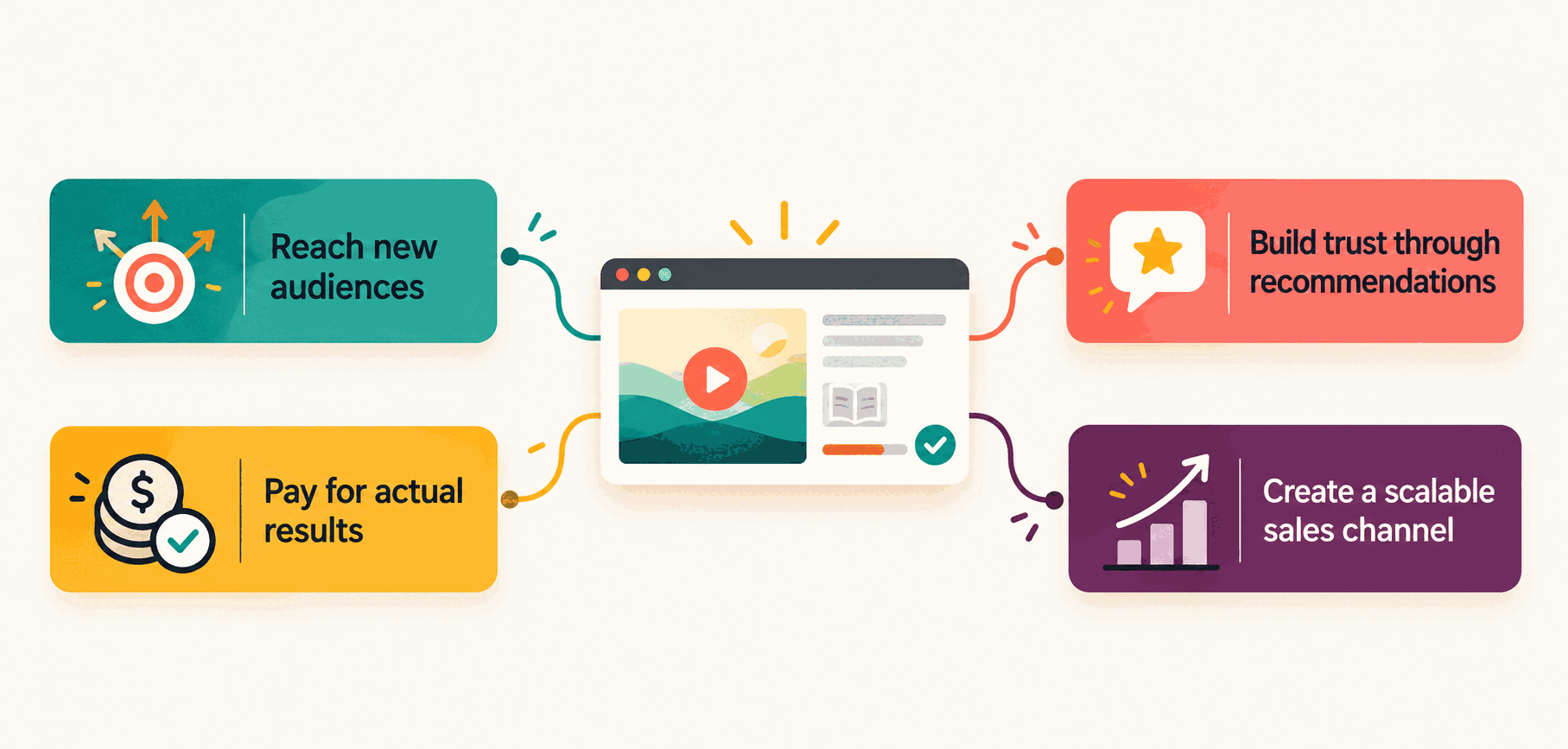
Reach beyond your existing audience
Building an audience takes time. Even if you have an established social media presence or email list, there are potential learners who may never come across your content.
Affiliates can introduce your course to those audiences.
A career coach may recommend a professional development course to their community. An industry expert can introduce a specialized course to their network. A creator who regularly teaches a particular skill can recommend a course to people who want to take their learning further.
The value lies in reaching people who already have an interest in the subject.
Connect marketing spend to sales
Affiliate marketing is a performance-based channel. Instead of paying just for exposure, you typically pay a commission when a referred learner makes a purchase.
That gives you a clearer connection between your marketing spend and the sales it generates.
It doesn’t mean that affiliate marketing has no costs. You still need to account for commissions, discounts, affiliate management, and the resources required to support your partners. But the model gives you a measurable way to evaluate the channel.
Encourage word-of-mouth recommendations
People who’ve taken your course may already recommend it to others. An affiliate program gives those recommendations a more structured path.
A recommendation based on firsthand experience can carry more context and credibility than a standard promotional post.
For course creators, this can turn positive learner experiences into another source of referrals.
How to choose the right affiliates
The number of followers an affiliate has is only one part of the picture. What matters more is whether their audience has a genuine reason to be interested in your course.
Start by looking for people who create content around your subject or serve the same type of learner.
If you sell a course on financial modelling, for example, a creator who talks about finance, business, or careers may be a natural fit. For a photography course, photographers, educators, and creative communities may be more relevant.
Look at how the potential affiliate interacts with their audience, too. Do people ask questions? Does the creator regularly teach or explain concepts? Do followers engage with their recommendations? Have they promoted educational products before?
Their relationship with the audience can tell you more than follower count alone.
It’s also useful to consider whether they understand your subject well enough to describe your course accurately. They don’t necessarily need to be an expert, but they should be able to explain why the course might be useful to their audience.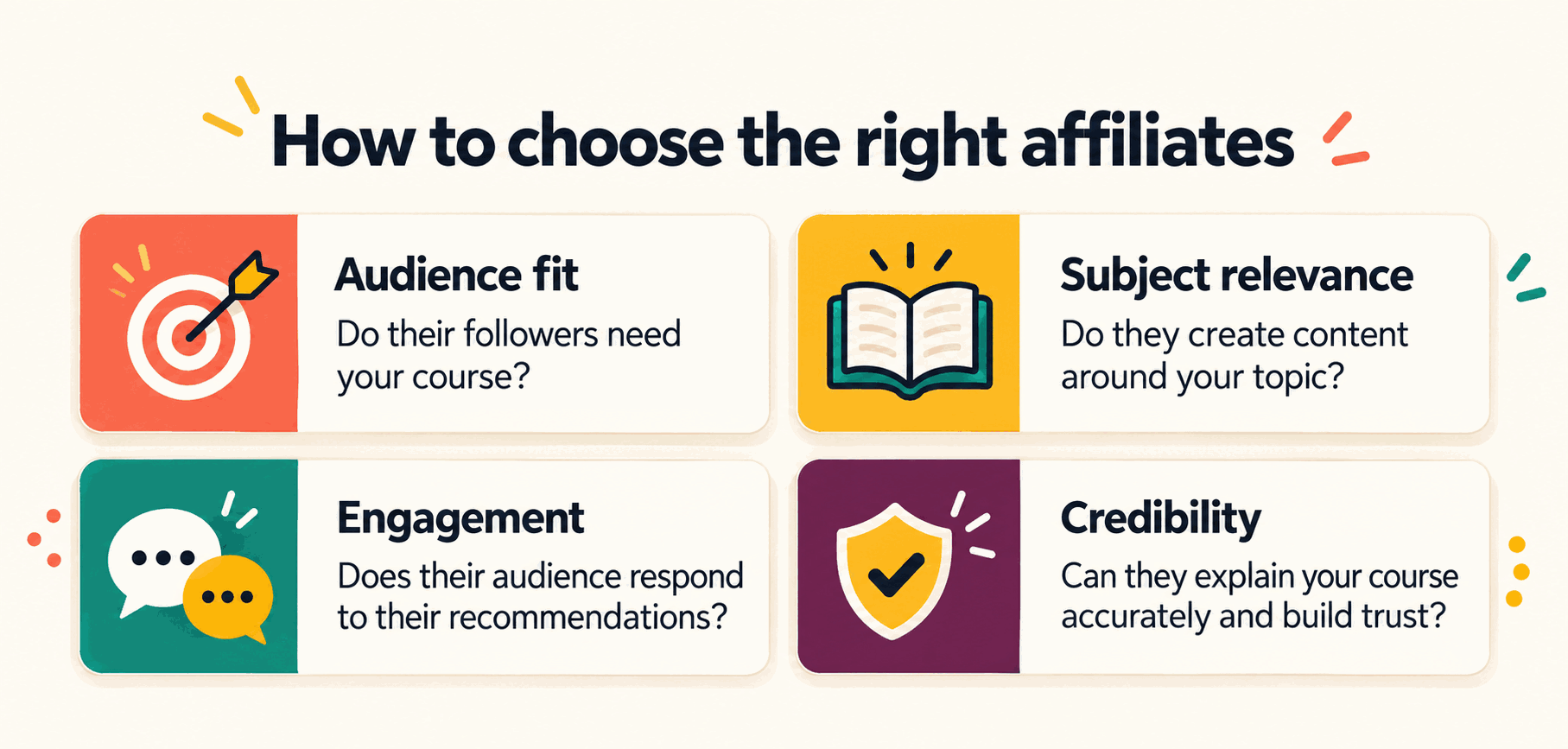
Set clear commissions and affiliate terms
Once you’ve identified potential partners, give them a program that’s straightforward enough to participate in.
Start with the commission. There isn’t a standard affiliate commission that every online course should use. A course priced at $30 has different economics from one priced at $500. Your costs, pricing model, refund policy, and margins all matter.
You may choose a percentage of each sale, a fixed amount per enrollment, or a tiered structure where affiliates earn more after reaching certain sales levels.
Whatever you decide, make the terms clear from the beginning. Affiliates should know what they earn, which purchases qualify, how long the referral window lasts, when commissions are paid, and how refunds affect their earnings. You should also explain how they must disclose the partnership and which promotional practices are permitted.
Clarity matters here. Complicated or unclear terms can discourage otherwise interested partners from participating.
Give affiliates the tools they need
Once someone joins your program, don’t simply send them a referral link and wait for the sales to come in.
Affiliates need enough information to understand your course and talk about it accurately. Give them the course overview, curriculum, instructor information, key benefits, pricing details, and answers to common questions.
Promotional assets can make the process easier, too. Course screenshots, sample lessons, videos, images, testimonials, and other approved materials give affiliates something to work with without requiring them to create everything themselves.
You can also provide suggested copy for different channels. A newsletter writer may need a short email introduction, while a video creator may want key points to include in a review or tutorial.
The idea is to make promotion easier without making every affiliate sound the same.
Help affiliates create content that converts
Affiliates don’t have to turn every post into a sales pitch.
In many cases, the most useful promotions begin with something the audience already wants to learn.
For example, an affiliate promoting a public speaking course could create a video about common presentation mistakes and mention the course as a way to develop those skills further. Someone promoting a photography course could publish a tutorial on composition and point interested viewers toward a more comprehensive course.
This approach gives affiliates room to create content in their own voice while keeping the course relevant to the topic they’re discussing.
Reviews, tutorials, comparisons, personal experiences, and educational posts can all work, depending on the affiliate and the audience.
The important thing is that the content should provide value even before someone decides to buy.
Build campaigns around launches and promotions
An affiliate program can run throughout the year, but certain moments give affiliates a stronger reason to promote your course.
Course launches are an obvious opportunity. You can also build campaigns around a major course update, a new certification, a limited-time offer, or a webinar related to the course.
Give affiliates enough time to prepare rather than sending them a promotion on the day it launches.
For a new course, for example, affiliates could introduce the topic before enrollment opens, discuss a problem the course addresses, and then share the course once registration begins.
This gives the campaign a natural progression and lets affiliates adapt the promotion to their own audience.
Make the course buying experience work
Getting someone to click an affiliate link is only the beginning.
The course page needs to give prospective learners enough information to make an informed decision. Someone discovering your course through an affiliate may be unfamiliar with your brand, so they should be able to quickly understand what the course covers, who it’s for, how it’s delivered, what it costs, and what they can expect to learn.
A clear curriculum, instructor information, sample content, learner reviews, course outcomes, and straightforward pricing can all help.
Your messaging should also match what the affiliate has promised. If an affiliate introduces your course as a way to develop a particular skill, the course page should clearly explain how the course addresses that skill.
The transition from referral to enrollment should feel straightforward rather than forcing the learner to search for basic information.
Measure sales and improve the program
Once your affiliate program is running, look beyond the number of clicks it generates.
Track referrals, enrollments, conversion rates, revenue, and commissions. These metrics can help you understand which affiliates are generating actual sales and which partnerships may need a different approach.
For example, one affiliate may send a large amount of traffic but generate few enrollments, while another sends fewer visitors but converts a much higher percentage of them.
You can also compare the types of content affiliates use. Tutorials may perform differently from reviews, newsletters, or social posts.
The purpose of tracking isn’t simply to identify your top affiliate. It’s to understand what is working well enough to repeat and what needs to change.
Common mistakes to avoid
Affiliate marketing can be straightforward to set up, but a few common mistakes can limit its effectiveness.
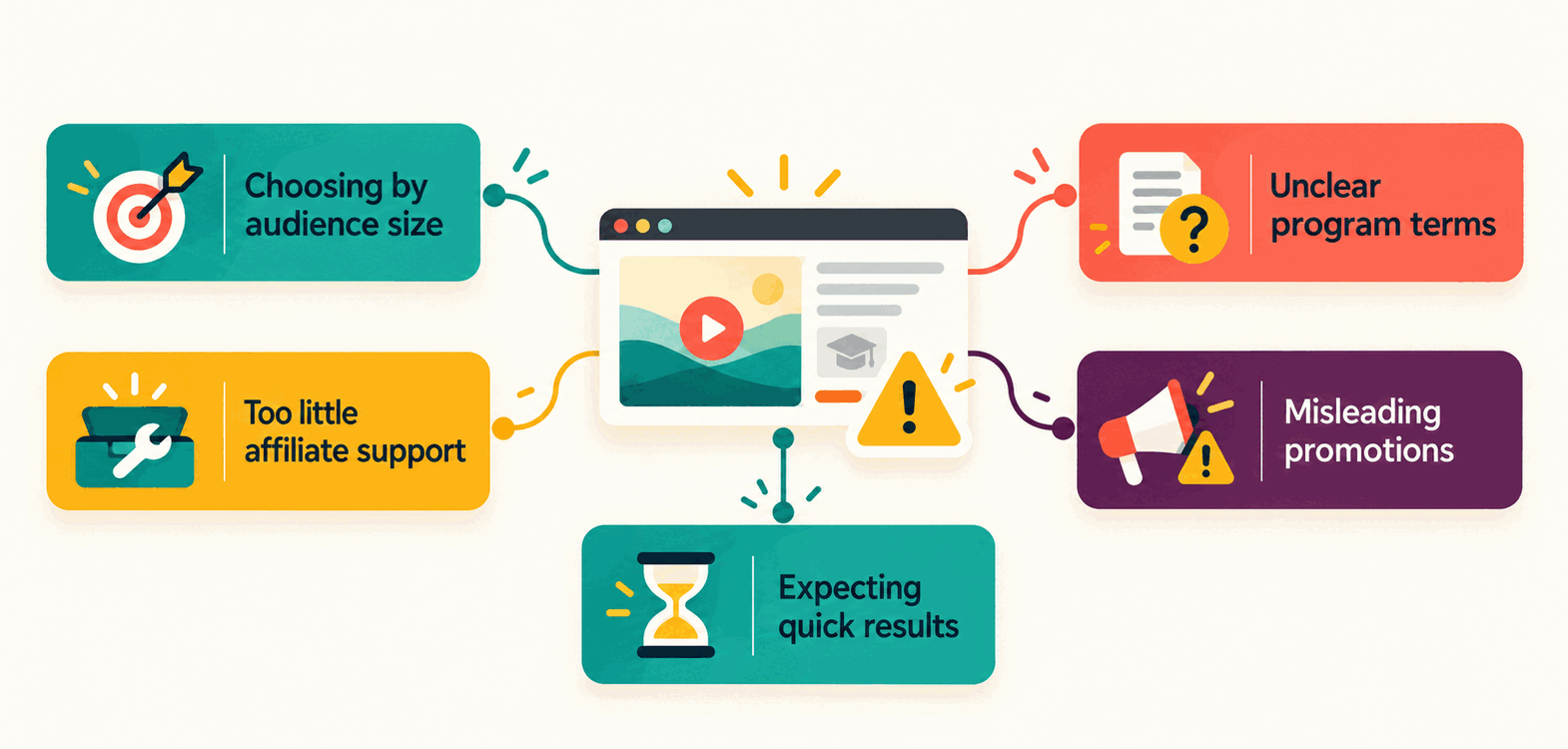
Choosing affiliates based only on audience size- A large audience isn’t necessarily a relevant one. Look at subject matter, audience fit, engagement, and credibility.
Making the program difficult to understand- Complicated commission rules or unclear terms can create unnecessary friction for potential partners.
Giving affiliates too little support- A referral link isn’t enough. Affiliates need accurate information and useful resources to represent your course properly.
Allowing misleading promotional claims- Affiliates shouldn’t promise outcomes that your course cannot reasonably deliver. Short-term sales aren’t worth compromising learner trust.
Expecting immediate results- Some affiliates may generate sales quickly, while others may need time to find the right format and audience for your course.
Build and sell your courses with TrainerCentral
Affiliate marketing is one part of building a successful online course business. You also need a platform that can support the course itself, from creating and delivering lessons to managing learners and selling your content online.
TrainerCentral brings the tools for building and selling online courses together in one platform.
Whether you’re launching your first course or expanding an existing online training business, TrainerCentral gives you a platform to create your courses, deliver training experiences, and manage your online training business.
With the right course experience and a thoughtful affiliate strategy, you can give more learners a reason to discover, explore, and enroll in your courses.
Wrapping up
Affiliate marketing works best when it becomes a natural extension of the way you already market and sell your courses. With the right partners, clear terms, useful promotional resources, and a way to measure results, it can become a repeatable channel for bringing new learners to your online courses.
FAQs
How can affiliate marketing increase online course sales?
Affiliate marketing can increase online course sales by helping course creators reach relevant audiences through individuals, communities, and businesses that already have established relationships with potential learners. Affiliates promote courses using unique referral links and earn a commission when their referrals result in a purchase.
How do I find affiliates for my online course?
Look for people who create content around your course topic or serve the same type of learner. Industry experts, educators, coaches, consultants, content creators, newsletter publishers, and satisfied students can all be potential affiliates.
What commission should I offer online course affiliates?
There’s no universal commission rate. The right amount depends on your course price, margins, business model, and marketing costs. The commission should be attractive enough for affiliates to promote the course while remaining sustainable for your business.
Can existing students become affiliates?
Yes. Existing students can become affiliates if they’re interested in recommending your course. Their firsthand experience can make their recommendations particularly relevant to people in their own networks.
How do I track affiliate sales?
Affiliate sales can be tracked using unique referral links or affiliate tracking systems that connect a purchase to the partner who referred the learner. Monitor metrics such as clicks, enrollments, conversion rate, revenue, and commissions to understand how the program is performing.