- HOME
- Building a business
- How to choose a franchisee training platform
How to choose a franchisee training platform
- Last Updated : August 24, 2026
- 45 Views
- 8 Min Read

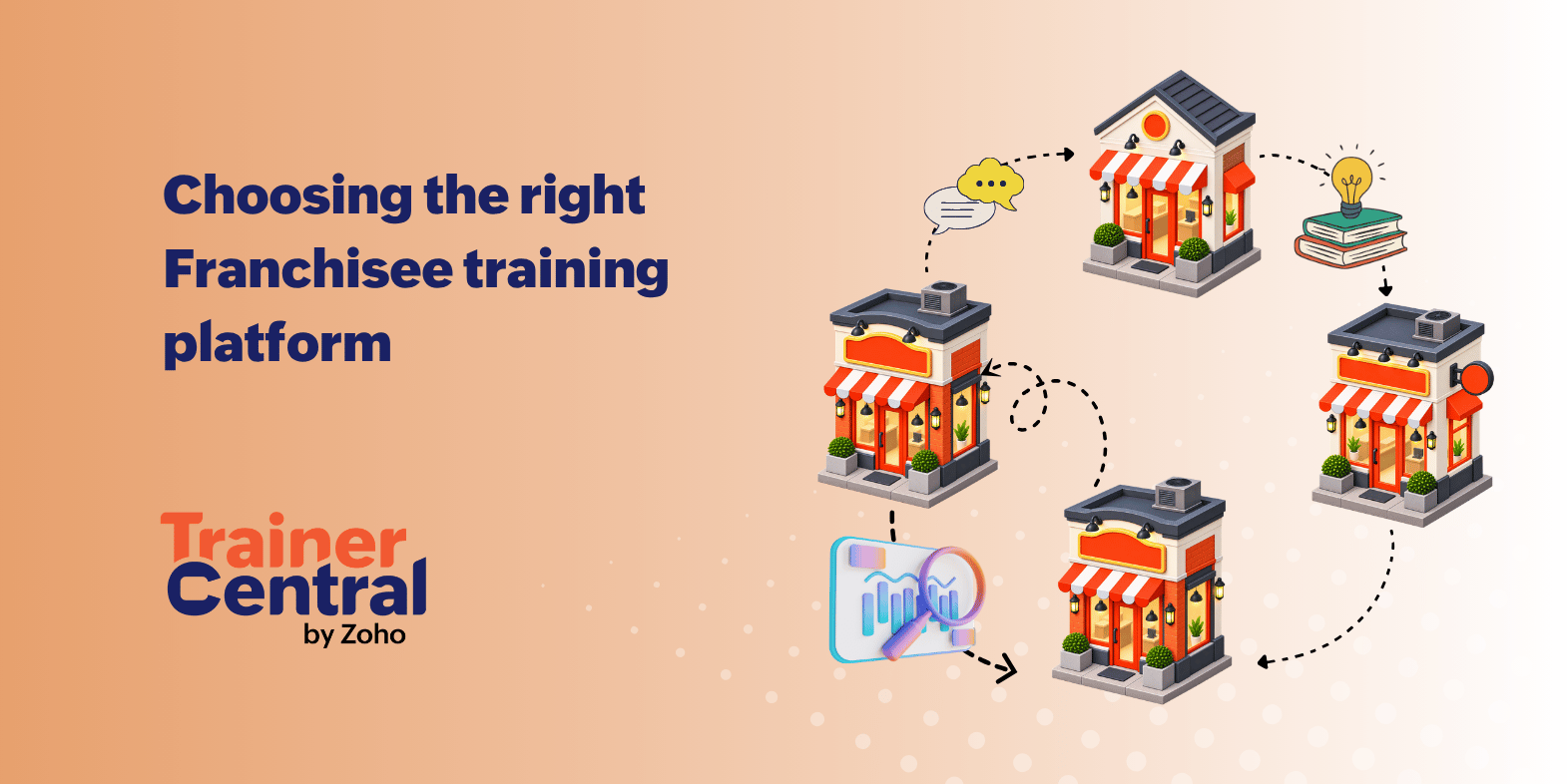
When it comes to selecting an online training platform for franchisees, there’s often the assumption that more features make the option more viable.
However, franchisee training is not a feature-counting exercise. In fact, you won’t be using every feature at every point of your course either.
There are certain factors to look into before committing to a training platform. These factors aren’t tied to what features they provide but, rather the specific capabilities they have that enable and enhance your workflow.
A training course covers the whole operational workflow, transforming a new business owner into someone who can represent the brand and apply its standards consistently.
What you are really comparing when choosing franchise training software
Businesses are not going to choose between two identical platforms. They are instead, comparing three fundamentally different approaches:
1. A collection of separate tools for meetings, files, tests, and spreadsheets.
2. A general-purpose software designed primarily to host and track courses.
3. A unified franchisee training platform that supports the complete journey from onboarding to readiness verification and continued development.
A fragmented tool stack may appear economical at the beginning: videos sitting in cloud storage, trainers running onboarding over a meeting platform, quizzes in a form builder, and so on.
The issue within the system becomes evident once problems start arising when you start scaling.
A franchisee completes the online modules but misses the live product demonstration or a regional manager cannot see which outlet employees passed their safety assessment. As the person (or group of people) maintaining the training stack, you have to ensure it's running smoothly but gaps are bound to arise when every corner of it is not taken care of.
A franchisee training platform should eliminate these gaps before it tries to add sophisticated learning features. Here’s a comparison on how different tools approach course creation and delivery.
Comparison criterion | Separate training tools | General purpose platform | Franchise-ready training platform |
Course delivery | Files and links distributed manually | Primarily self-paced courses | Structured self-paced, live, and blended programs |
Content management | Multiple copies across folders and inboxes | Central course repos | Central content with controlled publishing and reusable courses |
Live training | Requires a separate meeting platform | May depend on an integration | Built into the training workflow |
Assessments | Forms or standalone quiz tools | Usually supports basic quizzes | Tests, assignments, readiness rules, and certification |
Multi-tenancy support | Spreadsheet-based | Organization-wide reports | Learner, role, course, and location-level visibility |
Mobile learning | Depends on each tool | Browser access varies | Mobile-first or dedicated learner application |
Admin activities | Managed through email | Limited delegation | Groups, locations, managers, and admins synced up |
Regionalization | Inconsistent across tools | Limited language-support; may support subtitles | Provides multi-language support within the service, subtitles, as well as region-specific courses |
White-label capabilities | Inconsistent across tools | Basic logo and color settings | Branded academy, learner portal, and domain; could include a branded app |
Scalability | Administrative effort increases rapidly | Course scales, but workflows may remain fragmented | Content, delivery, reporting, and admin scale together |
In most situations, the third model is normally the strongest fit for franchise systems because it treats training as an ongoing operation rather than a one-time deal.
The key abilities franchisee training software must get right
Structured, multi-format learning programs
A long list of upload formats does not automatically create good franchisee training. The important question is whether the platform lets you organize those formats into a clear sequence that reflects how a franchise location actually becomes operational.
A new franchise owner may need to complete:
An introduction to the brand and franchise relationship
Business systems and financial administration
Location-opening procedures
Product or service knowledge
Health, safety, and compliance requirements
Brand and customer-experience standards
Hiring and employee onboarding
Point-of-sale or operational technology training
A final readiness assessment
Within those stages, different subjects call for different content. A short video can demonstrate customer service or a PDF can provide a printable opening checklist.
The software should let trainers combine various forms of content formats without creating a disconnected learner journey. A platform like TrainerCentral supports multi-format lesson materials and lets administrators structure content into chapters and lessons.
In a similar vein, structure also means controlling progression. Some operational subjects should be completed in order rather than treated as optional reference material. For example, a franchisee may need to pass food-safety fundamentals before opening advanced kitchen-process modules. TrainerCentral can make lessons prerequisites and can require a minimum test grade or a defined amount of lesson engagement before learners can continue.
When evaluating software, always ask vendors to demonstrate a real franchise curriculum rather than a generic sample course. Give them your onboarding stages and see how easily the platform reproduces them.
Content management that remains stable as the network grows
A franchise doesn’t remain static; its business model changes, design and PR guidelines change, and sometimes even the whole brand identity gets a new look. The training platform helping people behind the initiative shouldn’t remain static either. Therefore, the training service needs to solve two competing requirements:
Headquarters must be able to update training quickly.
Existing learners must not lose accurate progress records or encounter unfinished content unexpectedly.
At a minimum, look for a central material library, draft controls, scheduled publishing, course duplication, and a defined method for recalculating learner progress when lessons are added or removed. This duplication capability is useful in a franchise environment. The franchise’s HQ might even build a “brand operation” program and then create adapted versions for every employee layer such as new franchise owners, outline managers, international partners, and locations which have adopted a new service.
You need to gauge whether the platform supports content governance or just content dumping. There questions to ask here are the following:
Can a complete learner retain their status?
Can the business create a new version of this course for future franchisees?
Can mandatory retraining be assigned only to the locations affected by the change?
Live virtual training alongside self-paced learning
Just having self-paced course modules isn’t enough. While self-paced modules are effective for repeatable knowledge, live training is better suited to interpretation, demonstration, practice, and discussion. Franchisees may need to:
Watch a trainer demonstrate equipment.
Practice a sales or customer-service conversation.
Review a location-opening plan.
Participate in a product workshop.
Ask questions about an operational scenario.
Discuss regional challenges with other franchisees.
A strong platform should support both formats in one program. Learners should not have to search their inbox for a meeting link, return to another system for the recording, and then notify a trainer manually that they attended . With TrainerCental, you can do this easily with native live classrooms so learners aren’t scrambling to multiple places with confusing links.
Assessments that verify readiness rather than attendance
Assessment capabilities are one of the core requirements for any course. An effective franchisee training platform should support several levels of assessment.
Knowledge checks: To confirm understanding during a lesson. These can be short quizzes on terminology, product information, or procedures.
Summative tests: For evaluating whether learners have retained the essential content at the end of a module or program.
Assignments: To have franchisees demonstrate applied understanding by submitting a business plan, opening checklist, marketing proposal, store layout, recorded role-play, or local launch plan.
Certification: To create formal milestones once the required learning and assessment conditions have been met.
Progress tracking across learners, roles, and locations
The franchisor needs a network-wide view. Regional and location managers need a narrower operational view. Individual learners need to know what they have completed and what remains.
A franchisee training platform should therefore report at several levels:
Individual learner
Course or program
Assessment
Certification
Role
Franchise location
Region
Entire franchise network
Useful information includes enrollment status, lesson completion, time or engagement indicators, assessment scores, assignment status, live-session participation, and certificate status.
This also creates a practical accountability framework in terms of:
The HQ creating and controlling the training
Learners completing the required programs
Each location’s manager or moderator monitoring local participation
Headquarters retaining visibility across the academy
A regional manager can identify a location where several employees have not completed a new product module. A trainer can identify a test question that many franchisees answer incorrectly or an admin can spot certifications approaching renewal or cohorts struggling with a particular operational process.
Mobile learning for franchisees who are rarely at a desk
When it comes to flexibility, something like mobile access should allow learners to do more than watch videos. A useful mobile experience should support the principal learning journey, including accessing courses, attending live sessions, taking tests, submitting assignments, reviewing feedback, and downloading certificates.
TrainerCentral’s mobile app supports course access, tests, assignment submissions, live sessions, and certificates. TrainerCentral also offers white-labeled mobile apps for Android and iOS, enabling organizations to provide a more consistent branded learning experience.
A platform is genuinely mobile-accessible only when these common actions are straightforward on the devices franchisees actually use. Before going deep into the platform, ensure you can do the following on the app:
Find the next required lesson.
Resume an unfinished video.
Download an operational document.
Take a quiz.
Submit an assignment.
Join a live session.
Check completion status.
Retrieve a certificate.
Multi-location and multi-tenant administration
In its strictest form, multi-tenant software lets the franchisor manage multiple independent training environments from a parent console. Each tenant may have its own learners, administrators, branding, programs, and reports, while headquarters retains central oversight.
For a franchise system, each tenant could represent:
Individual franchise location
Multi-unit franchise owner
Country or region
Subsidiary brand
Master franchise partner
The benefit is separation without fragmentation. Each location sees only the users and information relevant to it, while the franchisor can control shared content and view network-level performance.
Before selecting software, determine how much separation you genuinely require. “Multi-location” and “multi-tenant” are not always interchangeable.
Ask the vendor these questions:
Can each location have a delegated administrator?
Can local administrators see only their own learners?
Can reports be filtered or exported by location?
Can headquarters view every location from one account?
Can the same core course be assigned to multiple locations?
Can a location add its own local content without editing the master program?
Can branding vary by location or subsidiary brand?
Can content updates be distributed centrally?
Does the service provide white-labeling to support personalization of web and mobile apps?
Does the service support regionalization in the form of multi-language support, subtitles, and region-specific courses?
Is there a hierarchy for brand, region, franchisee, and outlet ?
How TrainerCentral comes into the mix
TrainerCentral brings course creation, self-paced learning, live virtual training, assessments, certification, learner management, and analytics into one platform. Rather than asking a franchisee to move between a file repository, video-conferencing application, and spreadsheet, the brand can manage a connected learning journey.
Here is a possible workflow involving TrainerCentral.
Build the academy: Create a branded learner portal that represents the franchise and provides a consistent training destination.
Personalize and white-label: Continued from the section above, build your brand’s identity further for both your web as well as your mobile app.
Create role-based programs: Build separate courses for franchise owners, location managers, and frontline employees using video, documents, presentations, audio, and other lesson materials.
Control the sequence: Use prerequisites, drip scheduling, and course-compliance settings to guide learners through mandatory training in the correct order.
Add live onboarding: Schedule product demonstrations, operations workshops, system walk-throughs, and Q&A sessions through the built-in virtual classroom.
Verify learning: Use quizzes, tests, and assignments to assess knowledge and applied understanding.
Certify readiness: Issue branded certificates when the defined completion requirements have been met.
Review performance: Track enrollments, course completion, assessment outcomes, and certification from the administrative environment.
The above workflow gives the franchisor centralized control while making the learner's experience more coherent. It also shifts the training team’s time away from moving information between applications and towards coaching, content improvement, and franchisee support.
Frequently asked questions about franchisee training software
What is franchisee training software?
Franchisee training software is a platform used to create, deliver, manage, and track training for franchise owners, outlet managers, and franchise employees. It centralizes onboarding content, live sessions, assessments, certificates, and learning records so the franchisor can deliver consistent training across multiple locations.
What features should franchise training software include?
Franchise training software should include structured multi-format course creation, controlled content publishing, live virtual training, tests, assignments, certification, progress reporting, mobile access, branding, and multi-location administration. The exact feature set should reflect the franchise’s onboarding, compliance, and continuing-development workflows.
Why is multi-tenant support important in franchisee training software?
Multi-tenant support allows individual franchise locations, regions, or partners to be managed separately while headquarters retains central oversight. It can provide separate learners, administrators, branding, and reports for each location. Businesses should confirm the precise level of data isolation and delegated control offered by each platform.
Does franchisee training software have both self-learning and live learning workshops?
Yes. A blended platform can provide repeatable self-paced modules alongside live onboarding workshops, product demonstrations, coaching, and Q&A sessions.
Use TrainerCentral to create a fast-tracked training system for your franchisees. Try it out now!