- HOME
- E-Learning trends
- Beyond the classroom: How MEA’s training institutes are becoming hybrid academies
Beyond the classroom: How MEA’s training institutes are becoming hybrid academies
- Last Updated : October 5, 2026
- 0 Views
- 9 Min Read


For years, the training institute model across the Middle East and Africa was built around a physical place. Learners registered for a course, came to a classroom, learned from an instructor, completed an assessment, and left with a certificate.
That model still matters. Practical training, demonstrations, mentoring, discussion, and learning alongside peers are difficult to replace. But the classroom no longer has to carry the entire learning experience.
Across MEA, training providers are beginning to combine physical instruction with live virtual sessions, self-paced content, digital assessments, recordings, and continued access to learning resources. Our wider MEA research identifies this demand for hybrid learning as part of a broader shift in how training providers deliver and manage learning.
The change isn’t simply from offline to online. It’s from a course that exists mainly inside the classroom to an academy that can support learners before, during, and after it. That’s the idea behind the hybrid academy.
The classroom is changing, not disappearing
One of the clearest examples comes from Qatar.
Al Jazeera Media Institute’s 2026 training plan includes 294 courses across 155 specialized titles. For the first time, the institute introduced blended training as its own category, with six courses designed to be delivered simultaneously to onsite and remote learners. Two training halls have been equipped to support real-time interaction while participants outside Qatar join virtually.
What makes this interesting isn’t the videoconferencing technology itself. The physical classroom remains part of the experience. The change is that being outside Doha no longer automatically means being outside the classroom.
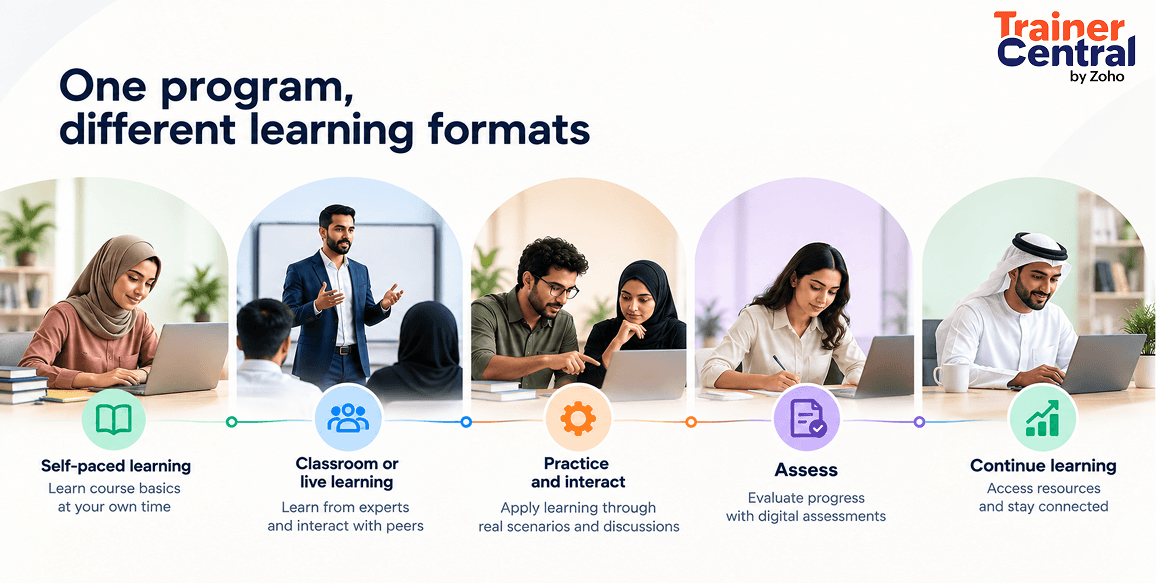
The UAE offers another model. The Emirates Institute of Finance offers in-person workshops, online courses, and blended learning experiences. Its blended pathways can combine classroom or live sessions with e-learning, microlearning, and mentoring, while its flipped programs ask learners to complete foundational e-learning before attending the instructor-led component.
This changes the question for a training institute. Instead of asking “Should this course be online or in the classroom?” it can ask, “What should happen in the classroom, and what can happen around it?”
Not every part of learning needs the same format
Think about a professional course.
A learner may not need to travel across a city to sit through an introductory presentation they could study independently. But working through a difficult scenario with an instructor, practicing a skill, discussing a real case, or receiving immediate feedback may be far more valuable live.
A hybrid model gives the institute room to design different parts of the program around the format that works best for them, rather than treating online and classroom learning as competing choices.
Egypt’s Information Technology Institute provides a useful North African example. Its professional and intensive programs use a hybrid structure combining onsite and online learning, supported by its MaharaTech digital learning environment.
Some ITI programs go further. Its 2D Graphic Design and Visual Communication track combines blended learning with project-based education, mentoring, industry apprenticeships, workshops, lectures, hands-on sessions, and collaborative discussions.
This shows how hybrid learning can combine different formats around the needs of the program rather than simply delivering the same class through two channels.
Why are training institutes moving beyond classroom-only delivery?
A classroom creates a valuable learning environment, but it also creates natural boundaries.
Learners have to reach the venue. Trainers have to be available at the same time. Each room has a capacity. Someone who misses an important session may have limited ways to catch up. And once the scheduled course is over, access to learning materials, instructors, and peers can quickly come to an end.
These limitations become more noticeable when institutes serve working professionals, corporate learners, or participants spread across cities and countries.
Hybrid delivery creates alternatives. A learner can prepare before arriving. Someone who cannot travel may be able to participate remotely. Course material can remain available between sessions. A learner who needs more time with a difficult topic can revisit it. Assessment and follow-up can continue after the physical session ends.
This doesn’t make the classroom less useful. It allows the classroom to focus more on what physical learning does particularly well: interaction, practice, feedback, mentoring, and human connection.
Across MEA, hybrid learning is becoming more structured
The shift is also visible in how training systems are preparing their trainers and institutions.
In Kenya, the Technical and Vocational Education and Training Authority (TVETA) is working with the Commonwealth of Learning to strengthen Open, Distance, and e-Learning across the country’s TVET sector.
In 2026, the initiative targeted more than 600 trainers and ODeL practitioners from 30 National Polytechnics and four Special Needs TVET Institutions. The program covers areas including digital course development, learning management systems, quality assurance, and accreditation, with National Polytechnics expected to establish functional ODeL Centres that improve access to training and the quality of skills development.
South Africa provides another signal. The Department of Higher Education and Training’s 2025/26 Annual Performance Plan says the department is exploring opportunities to maximize online and hybrid learning in response to high enrollment numbers.
The country’s own research on teaching and learning at TVET colleges also describes hybrid learning as combining technology with the value of face-to-face teaching, particularly where hands-on practice, multimedia instruction, classroom discussion, and different learner needs have to coexist.
Qatar, the UAE, Egypt, Kenya, and South Africa are very different training markets. Their models shouldn’t be treated as identical. But together, they show that hybrid learning is moving beyond an improvised digital alternative. It’s increasingly becoming a deliberate way to design and deliver training.
The harder part isn’t going digital, it’s keeping everything connected
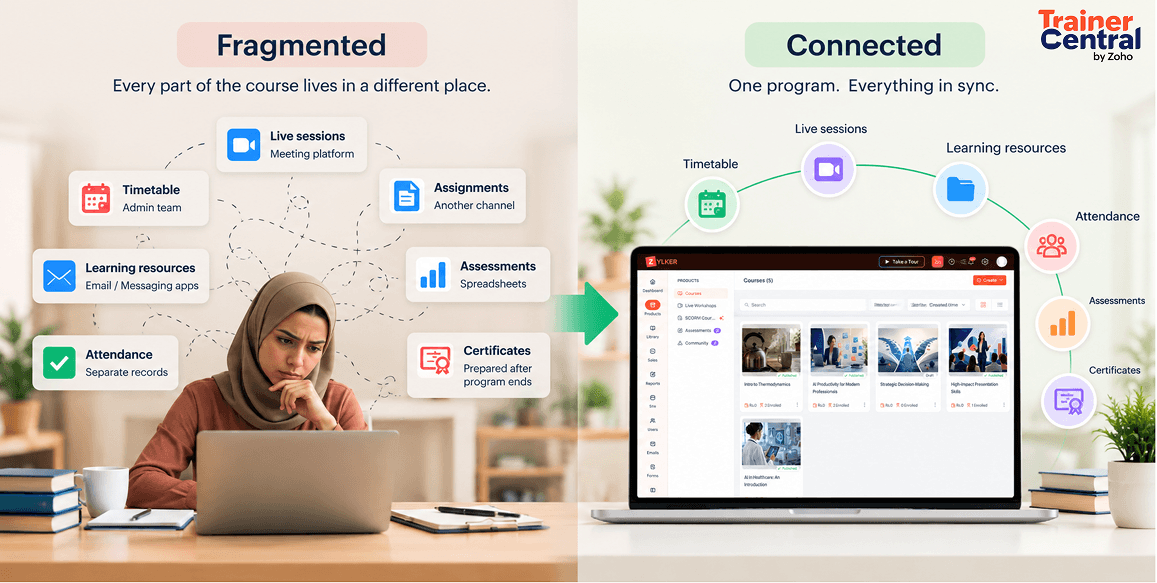
For an established training institute, adding technology is relatively easy. The operational challenge begins when every part of the course starts living somewhere different.
The classroom timetable may sit with the administration team. Remote sessions happen through a meeting platform. Trainers share resources through email or messaging apps. Attendance is maintained separately. Assignments arrive through another channel. Assessment results sit in spreadsheets. Certificates are prepared after the program ends.
The problem isn’t that any one of these methods is wrong. The problem is that the institute now has to keep the same learner, same course, and same learning outcome connected across all of them.
That creates a different kind of administrative burden. Was the prerequisite completed before the learner entered the classroom? Did the remote participant attend the live session? Has the assignment been submitted? Did the learner pass the assessment? Is the certificate ready? What should they learn next?
This is where academy digitization becomes more than adding an online class. The goal isn’t simply to have more digital tools. It’s to make the physical and digital parts of training feel like one program.
A hybrid academy changes the learner experience
Imagine someone enrolling in a professional certification program. A few days before the first session, the learner receives access to introductory material and completes a short prerequisite lesson.
They then arrive at the classroom already familiar with the fundamentals. The trainer can spend less time covering information learners could study independently and more time discussing real situations, demonstrating techniques, answering questions, and helping people apply what they’ve learned.
After the session, the learner still has somewhere to go. They can revisit course material, complete an assignment, prepare for the next class, or review a recording. If the program includes an assessment, it can become part of the same progression rather than a disconnected final activity.
And when the course finishes, the learning relationship doesn’t necessarily have to finish with it. The learner may move into an advanced program, return to reference material, or continue interacting with the academy. That continuity is one of the biggest differences between simply offering a hybrid class and operating a hybrid academy.
More reach doesn’t always require another classroom
Physical expansion has traditionally been one of the obvious ways for a training institute to grow. More learners can mean more classroom batches, more trainers, larger premises, or another location.
Hybrid delivery creates another option. An institute that already has strong trainers and proven programs can make suitable parts of that experience available beyond the immediate area around its training center.
For a learner in another city, joining selected sessions remotely may be more practical than traveling repeatedly. For a working professional, completing part of a program independently may make participation possible. For an institute serving corporate clients across locations, a common digital layer can support training delivered through multiple physical cohorts.
This is particularly relevant across a region as geographically broad as MEA. The opportunity isn’t simply to put more people into the same course. It’s to give different learners workable ways to participate while protecting the quality of the program.
And quality becomes more important, not less
A hybrid academy can expand access, but access alone isn’t enough.
Uploading a presentation isn’t instructional design. Recording a four-hour classroom session doesn’t automatically make it useful as self-paced learning. And opening a virtual meeting doesn’t guarantee that remote learners receive the same attention as the people sitting in the room.
The move to hybrid delivery therefore forces institutes to think more carefully about the structure of learning:
What should learners know before attending?
What needs an instructor?
Where is practice required?
How will remote learners participate?
How will progress be assessed?
What support is available between sessions?
A good hybrid academy needs the same mindset. Technology should support the learning model, not become the learning model.
Where TrainerCentral fits into the hybrid academy
For a training institute that already knows how to teach in a classroom, moving toward hybrid delivery shouldn’t mean rebuilding the entire operation as an online business. The more practical need is a digital layer around what already works.
TrainerCentral supports self-paced, live, and blended courses in the same training environment. Live virtual classes can run through its built-in classroom, while learners can also access course material, recordings, tests, assignments, and their own progress information from the same academy.
That makes it possible to connect activities that may otherwise sit in separate workflows.
A classroom cohort can receive a digital preparation before a session. Learners can access material between classes. A remote component can complement instructor-led delivery. Assessments and progress can stay connected to the course. And resources can remain available after the classroom session is over.
For institutes with existing digital course libraries, TrainerCentral 2.0 also supports SCORM content and tracks learner progress, scores, and completion. Its learner communities can provide a space for discussions and continued interaction beyond individual courses.
The value in a hybrid setting isn’t the number of features available. It’s having fewer gaps between what happens in the classroom and what happens outside it.
The next step isn’t to digitize everything
Not every course needs to become hybrid. Not every classroom session needs a remote audience. And not every piece of training content needs to become a self-paced module. A practical transition can start much smaller.
An institute may begin by putting prerequisite material online before a classroom program. It may give learners continued access to resources after training. It may introduce digital assessments. Or it may make selected instructor-led sessions available remotely where that genuinely improves access.
The right mix will depend on the subject, the learner, the trainer, and the market. That flexibility is the point. A hybrid academy isn’t defined by how much technology it uses. It’s defined by how deliberately it connects different ways of learning.
Beyond the classroom doesn’t mean without the classroom
The future of professional training in MEA doesn’t need to be framed as physical versus digital. The classroom remains valuable because people learn through interaction, practice, feedback, mentoring, and shared experience. Digital learning adds different strengths: flexibility, continuity, wider access, and the ability to support learners outside scheduled training hours.
The opportunity for MEA’s training institutes is to bring those strengths together. The classroom can remain where important learning happens. It just no longer has to be where all learning happens.
For the region’s training institutes, that’s what moving beyond the classroom really means: Building an academy where learning can begin before people arrive, become richer while they are there, and continue after they leave.
FAQ
What is a hybrid training academy?
A hybrid training academy combines physical instructor-led training with digital learning as part of one program. Depending on the course, learners may use self-paced content before class, participate in physical or live virtual sessions, complete digital assessments, access resources between sessions, and continue learning after the classroom component ends.
Does hybrid learning replace classroom training?
No. Hybrid learning allows institutes to decide which parts of a program benefit from physical interaction and which can be supported digitally. Practical work, mentoring, discussion, and feedback may remain classroom-led, while preparation, resources, assessments, and follow-up can happen digitally.
Is using Zoom enough to make a training program hybrid?
A video meeting can provide remote access to a live session, but a hybrid academy goes further. It connects the wider experience around that session, including preparation, learning material, participation, assessment, progress, and follow-up.
What should a training institute digitize first?
There’s no single starting point for every institute. A practical first step is to identify where learners or administrators experience the most friction. That may be prerequisite material, access to course resources, assessments, missed-session recovery, remote participation, or post-course follow-up. The aim should be to improve the learning journey rather than digitize every classroom activity.
How can TrainerCentral support a hybrid training institute?
TrainerCentral supports self-paced, live, and blended learning in one academy environment. Training institutes can use it to provide digital content around instructor-led programs, conduct live virtual sessions, manage assessments and learner progress, make recordings and resources available, and maintain learner engagement beyond individual classroom sessions.