- HOME
- E-Learning trends
- From followers to learners: The rise of creator-led education in MEA
From followers to learners: The rise of creator-led education in MEA
- Last Updated : October 20, 2026
- 0 Views
- 7 Min Read


Social media has become a place where professionals share their expertise and build audiences around what they know. As people engage with their content, some begin to look for more than occasional tips or tutorials. They may want a complete course, personal feedback, guided practice, or an opportunity to develop a skill they can use professionally.
For creators, this opens up an opportunity to move beyond publishing educational content and build structured learning experiences around their expertise.
Across the Middle East and Africa (MEA), social platforms are creating opportunities for educators, coaches, consultants, and skilled professionals to reach people who might never discover them through traditional training channels. The next challenge is turning that attention into meaningful learning.
Social media is becoming a starting point for learning
For many independent educators, the first interaction with a potential learner happens long before anyone visits a course website. A short tutorial can introduce someone to a new skill. A live discussion can help them understand a difficult subject. A series of practical examples can demonstrate how an expert approaches real problems. As people repeatedly encounter useful content, they begin to recognize the creator's knowledge and teaching style.
The scale of this discovery environment is particularly visible in GCC markets. According to DataReportal's Digital 2026 report for Saudi Arabia, the country had 34.4 million internet users at the end of 2025, with internet penetration reaching 99%. The report also estimated 38.6 million social media user identities in October 2025. These identities aren't necessarily unique individuals, but they illustrate the scale of social platform activity in the Kingdom.
The GCC is giving educational creators greater visibility
The growing significance of educational content is also reflected in how the region's creator ecosystem is developing. In January 2026, Dubai hosted the fourth edition of the 1 Billion Followers Summit, organized by the UAE Government Media Office. Its agenda brought together creators, technology companies, industry leaders, and businesses to discuss the future of the content economy.
One development was particularly relevant to education: the introduction of an Educator Award in partnership with TikTok, recognizing creators who use digital content to share knowledge and advance learning. The 2026 Educator Award went to creator, broadcaster, and author Matt Green, who received $100,000 for his contributions to digital education. Green's 1.4 million followers on TikTok tune in for his 30-second raps using popular soundtracks to break down scientific concepts for his students.
For educators across the GCC, this growing recognition presents an opportunity to build an audience around their expertise. However, turning that visibility into a professional teaching practice requires more than consistently publishing useful content. Creators also need to consider how they can help interested followers develop their knowledge and skills through a structured learning experience.
Nigeria shows why audience growth and creator income are different challenges
Nigeria offers another perspective on the creator economy. Its growing social media environment provides opportunities for people to build audiences around entertainment, professional expertise, technology, business, and education.
DataReportal's Digital 2026 Nigeria report estimated 109 million internet users and 47.8 million social media user identities in late 2025. It also reported that TikTok's potential advertising reach among adults increased by 43.4% between late 2024 and late 2025. These are platform advertising estimates, not a direct count of individual creators or learners.
While this expanding digital reach creates opportunities for creators to attract audiences, turning that attention into consistent income remains a challenge. The financial realities are reflected in findings covered by TechCabal's analysis of the Nigerian creator economy. According to the 2025 Nigerian Creator Economy Report, 56% of surveyed creators earn less than $100 per month, while only 3% earn more than $5,000. Although these findings don't represent every Nigerian creator's experience, they illustrate why monetization deserves attention alongside audience growth.
Followers and learners expect different things
Someone following an educational creator may enjoy a short explanation without wanting to study the subject in depth. A learner makes a different commitment. They may expect a clear starting point, a sequence of lessons, opportunities to practice, answers to questions, and some way to understand whether they're improving. If they're paying for a course, those expectations become more important.
Imagine a creator who regularly publishes short lessons on data analysis. A follower may learn how to use a particular spreadsheet formula from a 60-second video. That's useful, but it doesn't necessarily help them understand how to clean a dataset, interpret results, or complete a real analysis project.
A structured program can connect those individual lessons. It can begin with foundational concepts, introduce practical exercises, provide feedback, and help learners apply what they've learned.
This is the difference between sharing useful information and designing an educational experience. The creator's expertise remains central, but teaching requires more than the ability to attract attention.
The journey from social discovery to structured learning
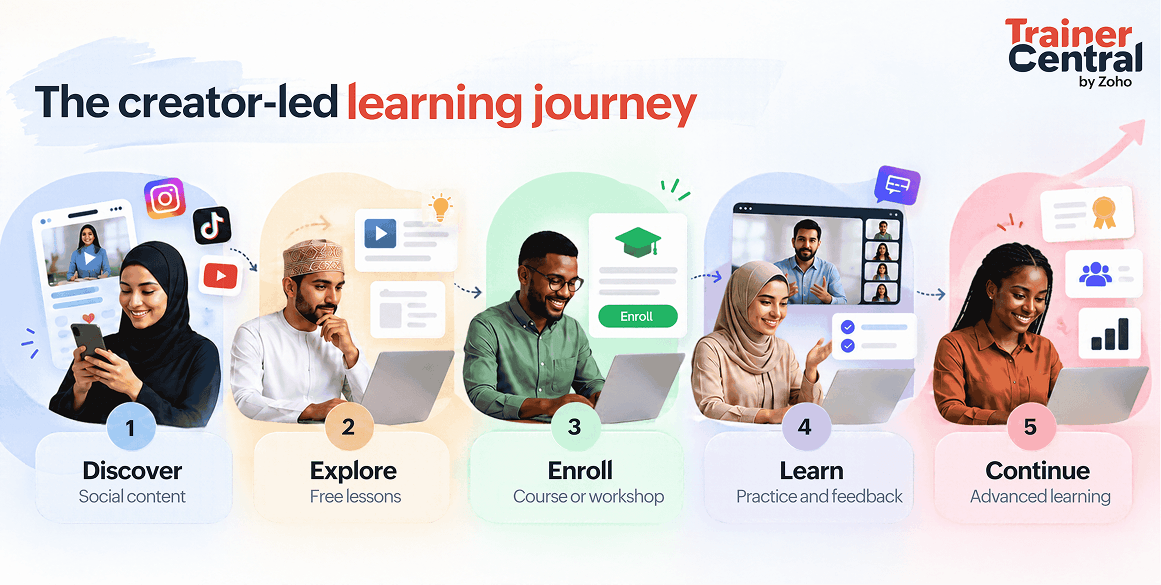
For creator-led education, the transition doesn't have to happen all at once. A creator can start by sharing free educational content. As people engage, questions and recurring challenges will reveal what the audience wants to understand more deeply.
That feedback can inform a short workshop or introductory course. Learners who find it useful may then be interested in a more advanced program, a practical cohort, or continued access to the educator's guidance. The progression might look like this:
The limits of running an education business through social platforms
The tools that help creators attract and communicate with an audience aren't always designed to manage a complete learning program. An educator might promote a workshop on Instagram, answer enrollment questions through WhatsApp, collect fees through a payment link, deliver sessions through a meeting application, and share recordings or assignments through separate services.
For a small program, this can be manageable. As more learners enroll, however, the creator has to keep track of who paid, who attended, which materials were shared, whether assignments were completed, and who needs additional support. The difficulty becomes especially noticeable when a creator offers several programs or wants learners to continue from one course to another.
Social platforms remain useful for discovery, communication, and community building. The question is whether they should also carry the responsibility for organizing the entire educational experience. A creator who wants to teach consistently may benefit from having a dedicated place where learners can enroll, access their courses, participate in sessions, and return to learning resources. This doesn't require abandoning the audience that's already been built on social media. It means giving that audience a more structured destination when they're ready to learn.
Where TrainerCentral fits into creator-led education
Once creators have identified what their audience wants to learn and how they want to teach it, the next challenge is delivering that experience consistently. This is where TrainerCentral can support the transition. Rather than using social media to manage every stage of the learning experience, creators can use TrainerCentral to build a branded academy where people can discover courses, enroll, and access learning materials.
An educator who has been sharing free lessons can develop those topics into self-paced courses or live workshops. Learners can follow structured content, participate in sessions, complete assessments, and return to resources through the same learning environment.
For creators developing paid offerings, TrainerCentral supports different course pricing models, including one-time payments, subscriptions, and installment options. Actual payment availability depends on the supported gateways and the creator's location. The platform also supports learner communities, allowing educators to create discussion spaces and maintain engagement beyond individual lessons.
Social platforms can continue helping creators reach new audiences, while a dedicated academy gives interested learners a place to study, interact, and continue their education.
The next opportunity is deeper learning, not just greater reach
Social platforms have opened new opportunities for professionals across MEA to share their expertise and reach potential learners. The longer-term opportunity, however, lies in what creators build beyond that initial attention. For creator-led education to become meaningful, creators need to think about the learning experience beyond the first video. What will learners be able to do after completing a program? How will they practice? What support will they receive? And what happens when they're ready to learn more?
Across MEA, the opportunity isn't simply for creators to sell more content. It's for professionals with valuable expertise to develop educational offerings that help people acquire skills, solve problems, and continue learning. A follower may discover an expert through a single post. A learner needs a reason to stay. That's where creator-led education begins to move beyond the social feed.
FAQ
What is creator-led education?
Creator-led education refers to learning experiences developed and delivered by independent creators, educators, coaches, or professionals who share their expertise with an audience. These experiences may include online courses, live workshops, coaching programs, and learning communities.
How can social media followers become course learners?
Creators can identify recurring questions and learning needs within their audience, then develop structured educational offerings around those needs. Free lessons, introductory workshops, and focused courses can help interested followers move toward deeper learning.
Do creators need a large following to sell online courses?
Not necessarily. A smaller audience with a clearly defined learning need may be more relevant than a large audience with limited interest in paid education. Course quality, audience fit, credibility, and learner outcomes all matter.
How does TrainerCentral help creators monetize their expertise?
TrainerCentral allows educators to create branded academies, deliver self-paced courses and live workshops, offer paid learning programs, and manage learner engagement. Creators can use these capabilities to build structured educational experiences around the expertise they already share.