- HOME
- Building a business
- The ultimate guide to franchise training: How the right software helps franchise businesses scale
The ultimate guide to franchise training: How the right software helps franchise businesses scale
- Last Updated : August 4, 2026
- 79 Views
- 7 Min Read

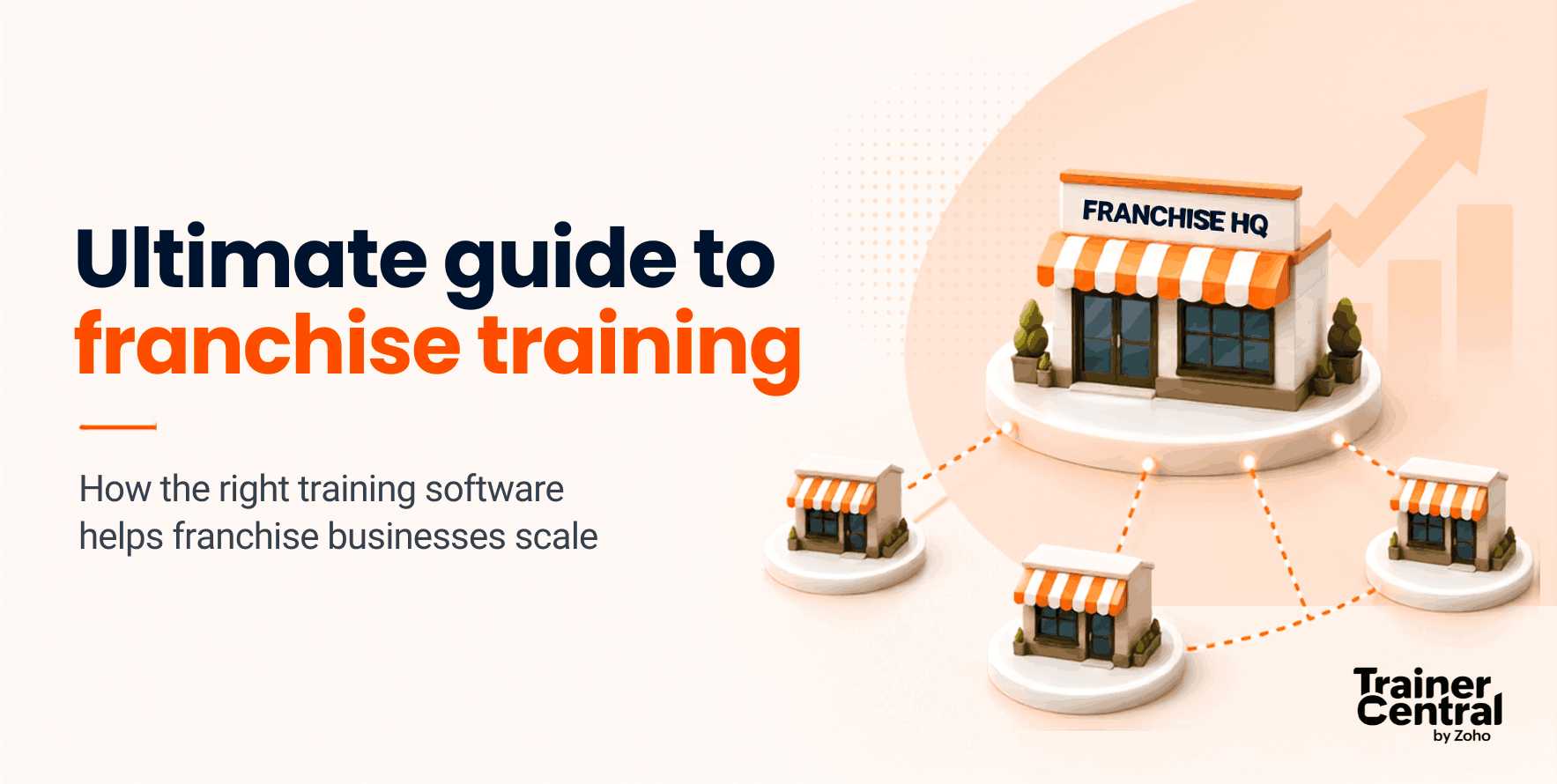
Expanding your franchise network is exciting, but maintaining consistency across every location becomes increasingly challenging as the business scales. Whether you’re opening your tenth outlet or your hundredth, every franchisee should deliver the same customer experience, follow the same operating procedures, and uphold your brand standards.
Many franchise businesses still rely on physical training sessions, printed manuals, shared folders, and emails to train new franchisees. While these methods may work for a few number of locations, they quickly become difficult to manage as the business grows.
The quality of training becomes inconsistent, updates are hard to communicate, and there’s little visibility into the training program’s performance.
This is where franchise training software becomes essential. It gives franchisors a centralized way to create, deliver, manage, and monitor training programs across every franchise location.
In this guide, you’ll learn what franchise training software is, why it matters, how to build an effective franchise training program, and the features to look for when choosing a platform.
What is a franchise training software?
Franchise training software is a centralized online training system that helps franchisors build and manage training for everyone down the chain, starting from owners, managers, to frontline staff. It streamlines the way different stakeholders are trained, certified, and updated that’s aligned with the business’s needs.
Instead of depending on disconnected tools for video meetings, document sharing, assessments, and learner tracking, everything is managed through a single platform. Training content, progress reports, certifications, and learner communications remain organized in one place, making it easier to maintain consistency across the franchise network.
Why does structured franchise training matter?
A franchise business model only works if its brand experience is consistent and repeatable. A customer walking into a location in New York, London, or Sydney expects the same product, the same service, the same feel. That kind of consistency doesn’t come from having a good business model on paper, it comes from how well you train people.
Without a centralized training system, franchisees start improvising. Maybe not on purpose, but it would eventually happen: One outlet does the checkout process differently, while another skips a step in customer service that the head office assumes is standard. Small drifts like that add up, and eventually they show up in customer experience and in how the brand looks from the outside.
Structured training also gets new franchisees up and running faster. Instead of a regional trainer explaining the same processes over and over to every new owner, there’s a set path to follow; operations, customer service, compliance—all of it laid out once.
Also, training doesn’t stop once a location opens. As the network grows, existing franchisees still need to know about new products, marketing pushes, process changes, regulatory updates. A centralized system is what makes it possible to push that out consistently instead of hoping it trickles down.
How to build an effective franchise training program
A successful franchise training program does more than just getting someone through their first week. It should help the franchisee to the point where they can run the business on their own, while still doing things the same way every other location does.
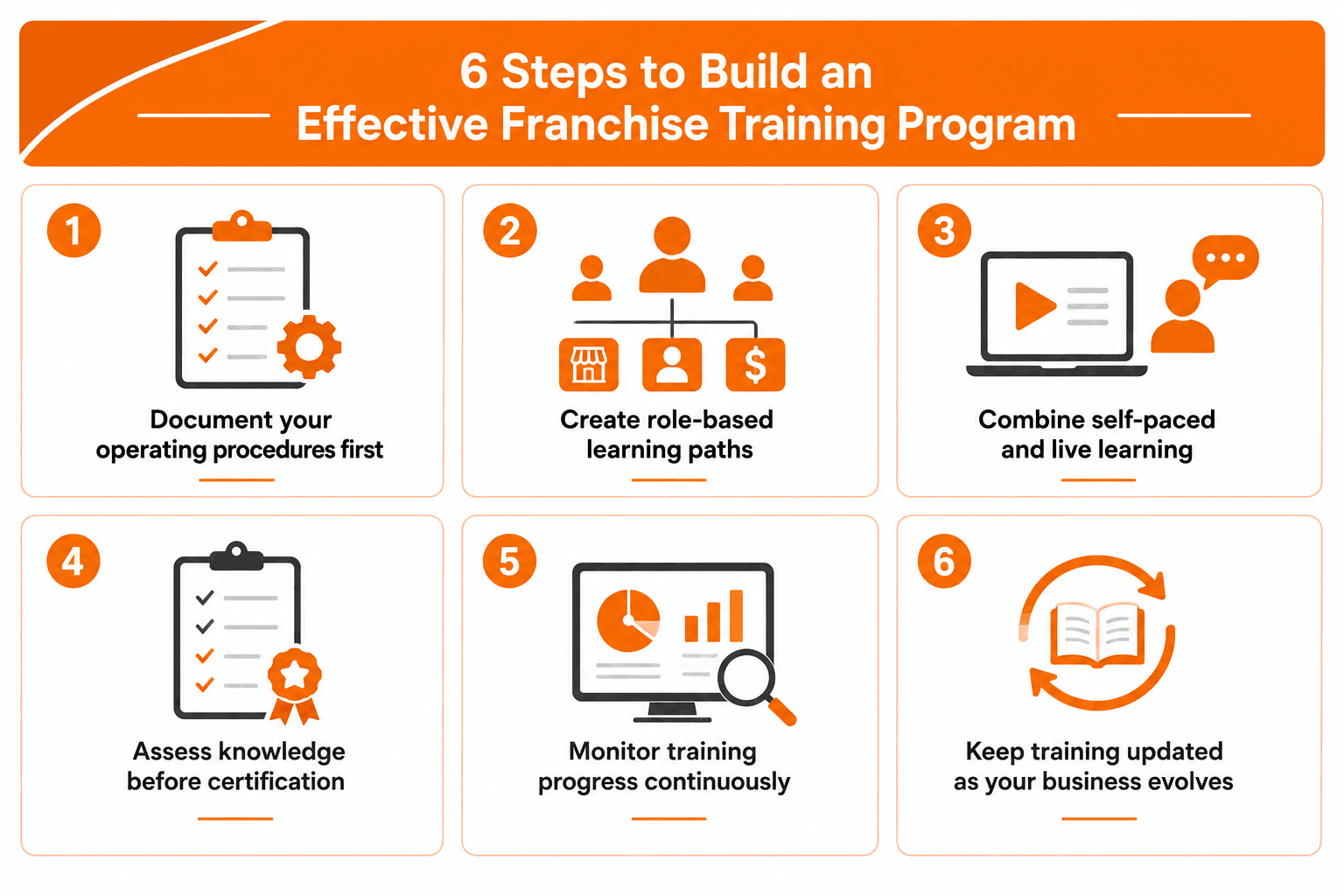
1. Document your operating procedures first
Before even creating a single training module, start by writing down how the business actually runs. Create a detailed overview of customer service standards, inventory, sales process, safety, marketing, brand rules—all of it.
Clear documentation forms the foundation of every training program. Without standardized operating procedures, training content quickly becomes inconsistent and difficult to update.
The upside of having it documented centrally is that when a process changes, all you have to do is simply update one document instead of retraining every location by hand.
2. Create role-based learning paths
Not everyone in a franchise business needs the same training.
A franchise owner needs to understand the business side: operations, finances, and brand strategy. A store manager needs a layer on top of that: staffing, scheduling, reporting, inventory. Frontline staff mostly need the practical stuff; how to talk to customers, knowing everything about the product, and understanding day-to-day operations.
Organizing training by role makes learning more relevant while reducing the time learners spend on unnecessary content. It also simplifies onboarding whenever new employees join an existing franchise location.
3. Combine self-paced and live learning
The most effective franchise training programs usually follow a blended learning approach.
Self-paced modules are good for standardized operating procedures, like SOPs, product knowledge, compliance, and brand guidelines. People move through it at their own speed and can go back and check something later.
Live training sessions are better suited for discussions, product launches, leadership updates, and technical interactions. Combining both approaches allows franchisors to reduce repetitive instructor-led sessions while still maintaining meaningful interactions with franchisees.
4. Assess knowledge before certification
Completing a course doesn’t necessarily mean a learner understands the material.
Including assessments as part of the training programs helps gauge how well people are trained and ensures brand consistency. Short quizzes after each module, some kind of practical assignment, a final assessment before certifying—all of it pushes people to actually engage with the content instead of clicking through slides to get to the end.
Certification also creates accountability and provides confidence that every franchise location meets the organization’s operational standards.
5. Monitor training progress continuously
One of the biggest advantages of franchise training software is visibility, being able to see what’s happening in real time.
It gives franchisors the ability to monitor enrollment, course completion, assessment scores, attendance, and certifications, all from a centralized dashboard. These insights make it easier to identify locations that require additional support and ensure that mandatory training is completed on time.
Instead of following up manually with individual franchisees, managers can quickly understand the status of their training programs through real-time reports.
6. Keep training updated as your business evolves
Franchise businesses are constantly changing. New products are introduced, pricing changes, operational processes improve, and compliance requirements evolve.
Training should evolve alongside the business. Instead of treating onboarding as a one-time event, successful franchisors continuously update their learning materials and provide refresher courses whenever major changes occur.
This ensures that every franchise location continues to operate according to the latest standards without relying on outdated manuals or verbal communication.
What features should you look for in franchise training software?
When choosing a franchise training software, don’t simply look for platforms that have a long list of features. Focus on the core capabilities and how well it suits your training methods and workflows.
A good platform should make it easy to create structured learning programs using videos, documents, presentations, and support deliver an immersive learning experience.
As training scales, content should remain organized and simple to update without affecting learners already enrolled in courses.
The software should also support live virtual training alongside self-paced learning. This gives businesses the flexibility to conduct onboarding sessions, product demonstrations, workshops, and Q&A discussions without switching between multiple tools.
Assessment capabilities are equally important. Built-in quizzes, assignments, and certification programs help ensure that franchisees understand operational procedures before applying them in the real world.
Progress tracking is another essential capability. The brand and managers should have complete visibility into learner progress, course completion, assessment performance, and certification status across every franchise location.
As many franchise owners and employees spend much of their day away from a desk, mobile accessibility has become increasingly important. Training should be available on any device so learners can continue progressing regardless of their location.
Finally, look for software that supports multi-tenant support. In simple terms, this should be one centralized console where you can manage every location independently: separate data, separate reporting, instead of everything getting mashed together.
How TrainerCentral helps franchise businesses manage training
TrainerCentral helps franchisors centralize every aspect of franchise training through a single platform. Businesses can create structured self-paced courses, conduct live virtual training sessions, assess learner knowledge, issue certificates, and monitor training progress from one dashboard.
The platform also supports role-based learning programs, enabling organizations to deliver different training programs for franchise owners, managers, and frontline staff.
With the centralized reporting and learner management, franchisors can monitor training across multiple locations while ensuring that every franchise receives the same learning experience. These capabilities align with TrainerCentral’s focus on helping businesses deliver consistent and scalable online training programs.
Online franchise training software vs. traditional training methods
Traditional franchise training relies heavily on classroom sessions, printed manuals, email communication, and shared documents. While these methods can work for smaller franchise networks, they become increasingly difficult to manage as the business grows.
Every process update requires new documentation, repeated training sessions, and continuous follow-ups to ensure that every location stays aligned.
Franchise training software replaces these fragmented processes with a centralized learning environment. Training content can be updated once and made instantly available across the entire franchise network.
Traditional franchise training methods | Online franchise training software |
Classroom sessions and printed manuals | Self-paced courses and live virtual training |
Email and shared folders for content | Centralized learning platform |
Manual attendance tracking | Automated learner tracking and reporting |
Difficult to update training materials | Instant content updates across all locations |
Limited visibility into learner progress | Real-time dashboards and analytics |
Inconsistent training across locations | Standardized learning experience for every franchise |
As franchise networks continue to expand, the biggest advantage of training software isn’t simply delivering courses online. It’s the ability to maintain operational consistency while significantly reducing the effort required to onboard and support every franchise location.
Final thoughts
Franchise growth depends on consistency. Every new location should deliver the same quality of service, follow the same operating procedures, and uphold the same brand standards that made the business successful in the first place.
A structured franchise training program provides the foundation for achieving that consistency. The right franchise training software makes this process easier by bringing content, learners, assessments, certifications, and reporting together in one centralized platform. As your franchise expands, having a scalable training system becomes just as important as having a scalable business model.