- HOME
- Building a business
- Why do most online courses fail? Simple ways to validate your course ideas
Why do most online courses fail? Simple ways to validate your course ideas
- Last Updated : July 24, 2025
- 347 Views
- 6 Min Read


Okay, let’s be real. Creating an online course takes a considerable amount of time, effort, and resources. From coming up with content ideas, recording course videos, setting up the sales pages and payment workflows—it’s a lot of work.
What if, after all of that hard work, nobody purchased your courses?
Unfortunately, this is the harsh reality that many first-time course creators face, sometimes even the seasoned ones. It’s not because the course creator lacked expertise or because the content was poor, but because the course was built for an audience who didn't actually want it.
A course creator spends days and weeks crafting course videos, designing modules, and setting up sales systems. But after the launch, they’re greeted only by daunting silence. No leads, no enrollments, no buzz. Maybe a polite “looks sound!” from a close friend, but no real traction.
If you’re reading this blog post, there's a high chance you’re already planning to build your own course.
Before you hit record or jot down your storyboard for your first course module, pause and ask: “How do I know people will actually buy my course?”
That’s what this blog post is about—validation of your course ideas.
We’re going to explore a simple, powerful process to ensure your course ideas have real market demand before investing your precious time and energy into building it.
The harsh truth: Building doesn’t equal selling
Most creators assume that if they build a good quality course, people will buy it. Sounds logical, right? Then why do most course businesses fail to take off?
If you take a step back and focus on the reason why most course businesses fail, you will notice a common pattern:
The course creator has probably skipped the market research and idea validation process.
They wouldn’t have tested the waters to see if:
- There was an actual demand for their course idea.
- People would even be willing to pay.
- The idea solves a real, urgent problem.
''Build first, hope later'' is the trap that many course creators fall into. A course is simply a product that’s going to solve a real life problem, so a thorough understanding of the product market fit is crucial for success.
Validate your course ideas before you build
Course validation is the process of testing your idea before you build your full course. It’s a way to gather proof and make informed decisions when getting started.
The course validation process is actually simple and quick when it’s broken down as small steps.
Let’s take a look at a four-step method that you can follow.
Step 1: Define your target learners and problem statement
First, identify who your target audience is and the type of problem you’re trying to solve for them.
For a course about photography, for example, you can start from a broader view. The starting point could be “people who are interested in photography,” and you can narrow it down from there.
To narrow it down, you could ask these questions.
- Who exactly are these learners?
- Why are they learning photography?
- Do they need any specific camera gear?
- What do their day-to-day challenges look like?
- What are they trying to achieve, and what’s holding them back?
So, instead of saying: "A course for anyone who is interested in photography."
The better approach could be: "An expert-level course for professional wedding photographers who are struggling to impress their clients and grow their business."
This level of pin-pointing the clarity of the target audience sharpens your course idea, making the whole course contextual to them and easier to market.
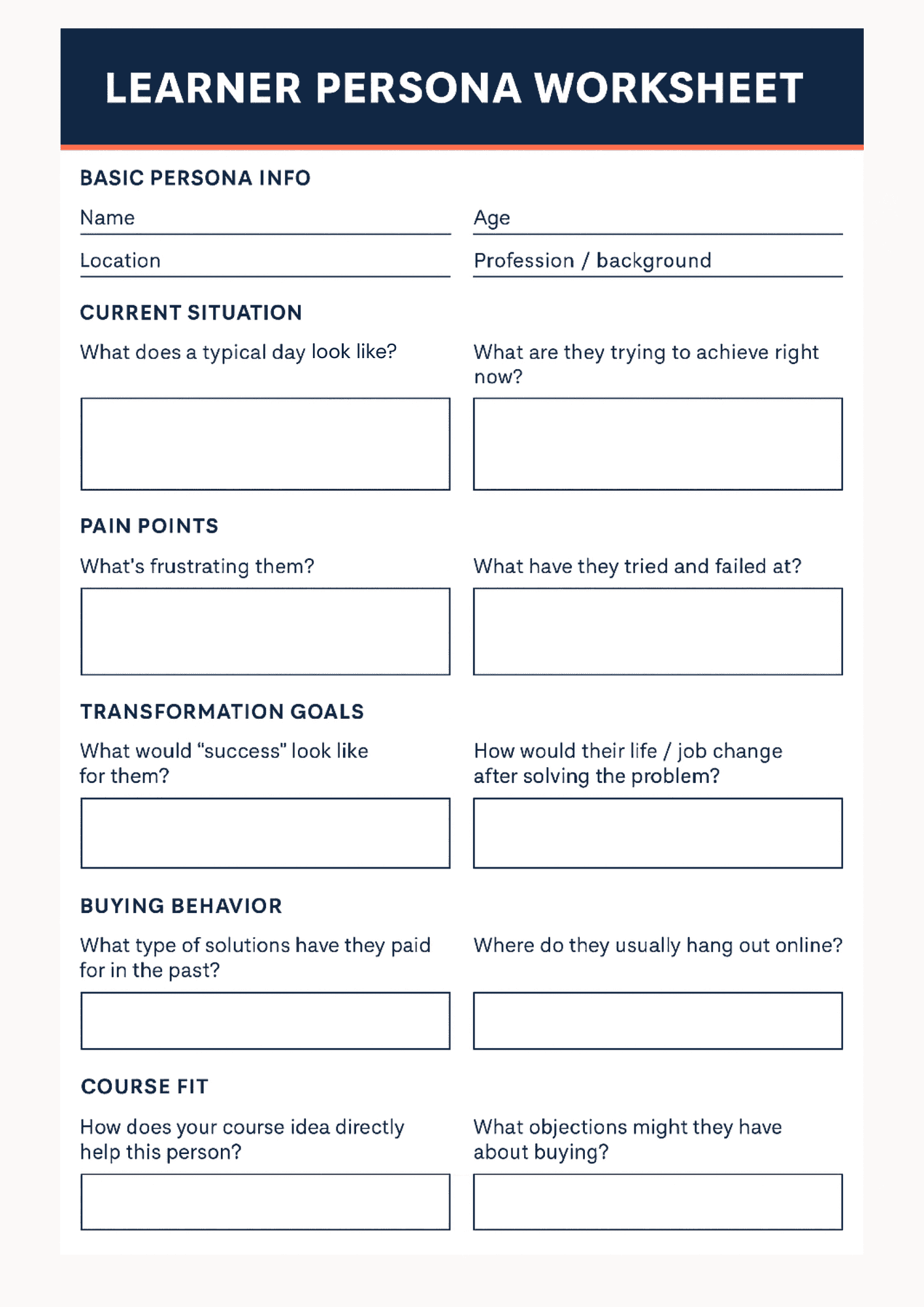
If you're not sure how to define your target persona, download this learner persona building worksheet (a free PDF). Simply answer the questions from your perspective, and you’ll eventually gain the clarity you need.
Download our learner persona building worksheet here.
Step 2: Talk to real people
The previous step of building the target learner persona is your perspective of approaching a particular problem. You’re making an experience-based conclusion that the audience is facing an issue and your product (course) can help solve it. Your strong conviction about a topic may be much different in reality.
The next important step is to talk to real people and see if they feel the same. This is the most important part that unfortunately most people skip, but there are different ways you can do this.
Join a community or participate in events, intentionally meet people who you think are relevant to your niche, and ask questions that can shape your ideas.
You can ask questions like:
- What’s the hardest part about [a topic] for you?
- What have you tried already? What didn't work?
- What type of assistance do they need to thrive?
- What are their aspirations?
- What’s their willingness to invest time and money to achieve a particular goal?
These are some outline questions to give you an idea on how to build conversations.
Don't try to sell anything; simply build conversations and unearth people's minds.
You'll discover some common words, phrases, and pain points. Patterns will emerge, and that's your gold mine.
If you aren't able to meet people in person, try online forums like Reddit, Facebook, or Instagram.
Create a survey with all of the required questions and share it in forums where your targeted audiences are. You can also directly reach out to people and request them to fill out your questionnaire.
Step 3: Conduct research using public data
So far, you've heard what people have to say and how you feel about your course idea. Now, let's see what people on the internet search, which can corroborate what you've learned so far.
There are many tools online that will help you understand people's search behaviors and trending topics.
Google Trends: This tool helps you find topics that are trending in a particular region. For example, you’ll be able to identify how many people are searching for “mobile photography” in a particular region. This data will give you insights on whether people are actually looking for such topics.
AnswerThePublic: Using this tool, you’ll be able to identify the questions people ask around a particular topic on search engines. This will help align your messaging and craft more compelling stories.
Ubersuggest or Google Keyword Planner: These tools give you an estimate of search volumes and keyword difficulty. These insights will help you understand the competition, identify untapped segments, and give you a basic understanding of marketing strategies.
Step 4: Build a micro-MVP and test
Now that we’ve done all of the research and have a clear understanding of what's in demand and which course ideas have a better chance of succeeding, the next step is to test them in a real-world setting.
Start by building a micro-MVP (minimum viable product), which is a small, simplified version of your course. In our case, it will be a mini-course module to test the waters before deep diving into building the full-fledged course.
1. You can offer a free, one-page, downloadable PDF template on camera settings for wedding photographers. More downloads indicate higher interest and potential for course sales.
2. You can do a short 2-minute teaser video introducing your course concept. Higher engagement signals there's a demand for the particular concept.
The goal is to have 5% to 10% of your audience engage or take a certain action. If you reach that mark, you’re on the right track. And if some people start asking, “When is this course launching?” you've clearly struck a chord.
Share your micro-MVP on social media platforms and forums. You can also share it with the people you interviewed early and ask for feedback.
Final thoughts
Success doesn't come from guessing, it comes from listening, testing, and analyzing. It's important to think from your audience's point of view.
Simply put, this whole course idea validation exercise is about looking at a problem through the lens of your target learners.
Following a step-by-step validation approach like this brings greater clarity and significantly improves your chances of building a successful, highly demanded course.