- HOME
- E-Learning trends
- White-label training platform vs. course marketplace: The ownership gap no one talks about
White-label training platform vs. course marketplace: The ownership gap no one talks about
- Last Updated : March 2, 2026
- 146 Views
- 7 Min Read

A white-label training platform and a course marketplace solve the same problem in fundamentally different ways. Choosing between them has long-term consequences for your brand, your learners, and most importantly, your revenue. It’s an important and difficult decision.
While the online training industry expands rapidly, organizations, creators, and training providers need to clearly understand what each model gives you and what they don’t.
To stop the analysis paralysis the decision may cause, let’s break down the real ownership differences between a white-label course platform and marketplaces, helping you choose the right model based on your business goals.
Why white-label matters
A white-label online learning platform allows you to deliver training fully under your brand identity. The platform infrastructure exists behind the scenes, but learners interact entirely with your branded website, domain, visual branding, and communication channels. A recent study by Marq reveals that 60% of companies report that consistent branding contributed 10% to 20% to their revenue growth.
Learners feel connected to your brand identity. They associate authority and credibility with consistent brand experiences.
- Learners see the training as intellectual property.
- Trust strengthens the learning experience and certificate value.
- Brand recall value leads to increased repeat engagement and word-of-mouth recognition.
In contrast, marketplace learners often associate the training primarily with the marketplace brand rather than the instructor or organization.
Ownership comparison
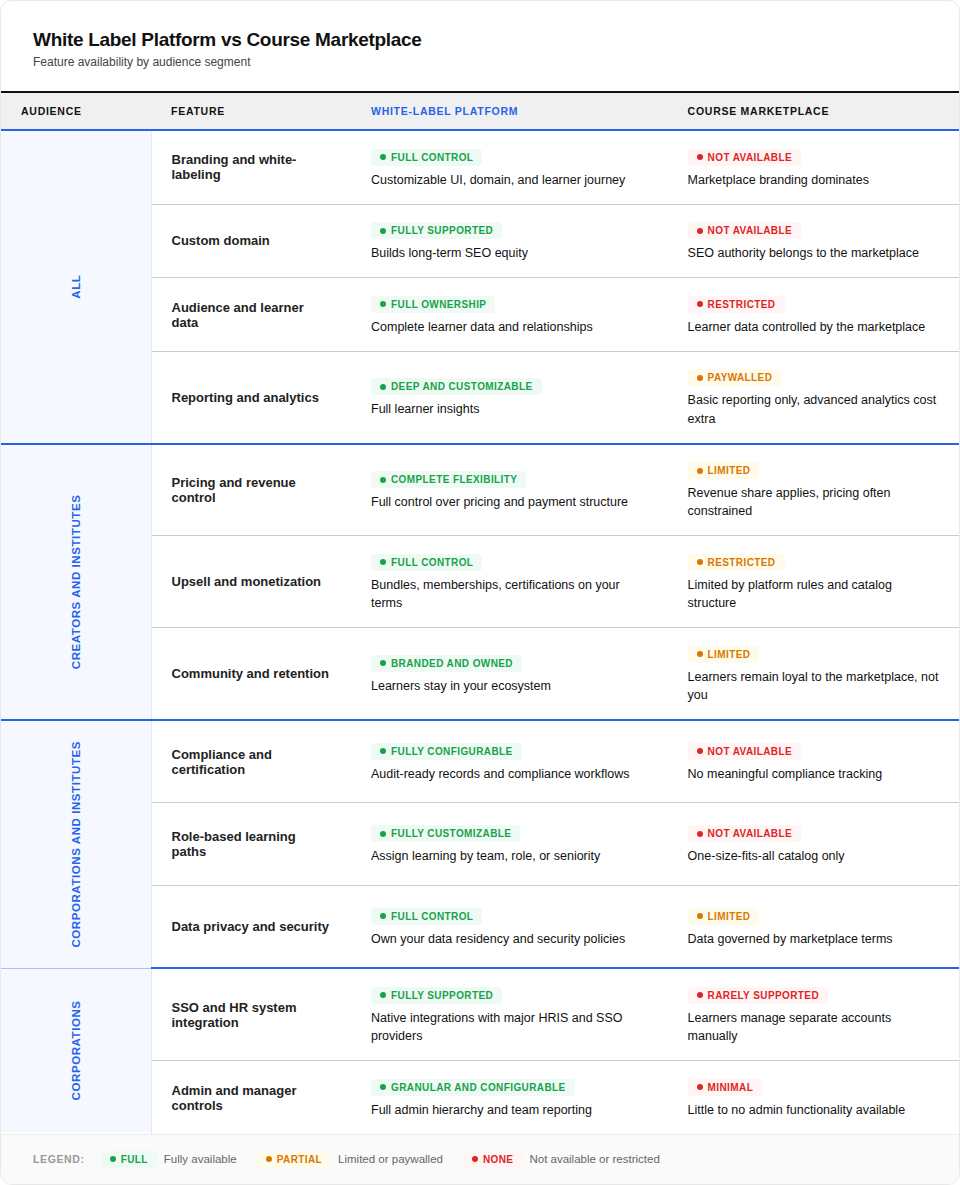
White-label course platform advantages
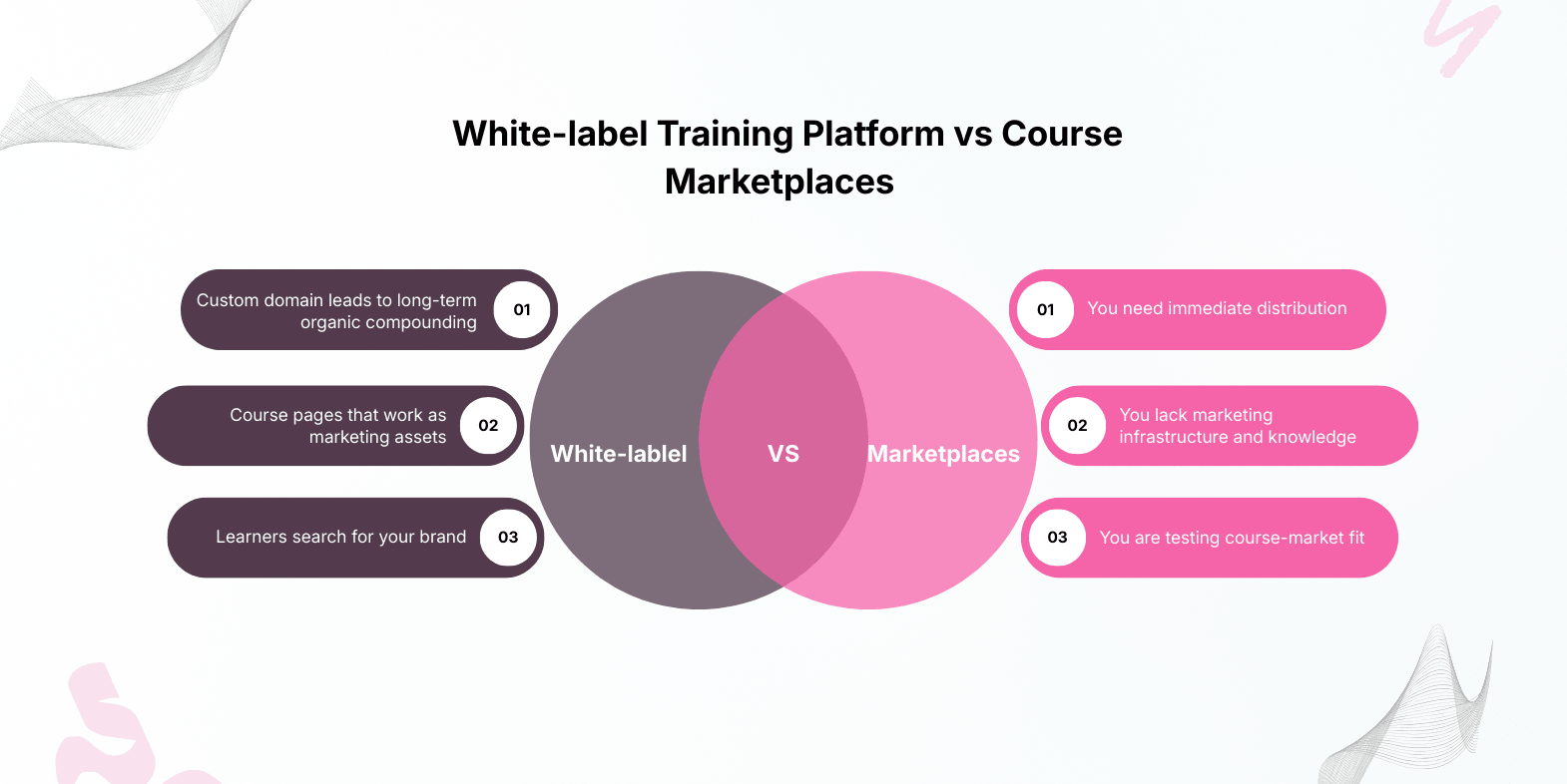
Custom domain leads to long-term organic compounding
A white-label online learning platform lets you host training under your own domain; for example, academy.yourbrand.com. This matters more than most people realize. Every course page, certification program, and blog post you publish builds authority on your domain, not someone else’s. According to Ahrefs, 96.55% of pages receive zero organic traffic from Google, and a lack of domain authority is one of the primary reasons. When you own your domain, you’re investing in an asset that compounds; more pages, more backlinks, more topical authority in your niche over time leading to increased learner trust and brand value.
Course pages that work as marketing assets
On a white-label platform, every course or certification page can pull double duty. It’s not just a product listing—it’s an SEO landing page, a paid campaign destination, and a content marketing conversion point all at once. Instead of standalone products, you’re building a library of demand generation assets that drive traffic and convert visitors independently of any paid spend.
Learners search for your brand
Over time, the most valuable traffic you can earn is people searching for your programs by name. That only happens when learners associate the courses with your brand and not with the platform. As brand-led discovery grows, customer acquisition costs fall and loyalty strengthens. Edelman’s research found that 81% of consumers say brand trust is a deciding factor in purchase decisions, and that trust is built through consistent, branded experiences, not marketplace listings.
When a marketplace is actually better
Choosing a white-label platform isn’t the right move for everyone because marketplace platforms still provide strong advantages, particularly in early growth stages. Here are some examples of when marketplaces make more sense.
You need immediate distribution
Building an audience from scratch takes time. Marketplaces like Udemy or Coursera come with millions of active learners already browsing for courses, which means a new creator can get in front of hundreds of potential students from day one without any marketing spend. If your primary goal right now is validating whether people actually want what you’re teaching, a marketplace removes the friction between you and that answer. You find out fast, without having to build infrastructure first.
You lack marketing infrastructure and knowledge
Running a white-label platform means you’re responsible for your own traffic. That requires SEO capabilities, demand generation systems, paid media, email marketing, and at least some brand recognition to build on. If those aren’t in place yet, and you’re still in the learning stages, a marketplace effectively handles go-to-market complexity for you. You give up ownership in exchange for not having to build a marketing engine from scratch before you’ve even proven the product.
You’re testing course-market fit
Before investing in a branded platform, it’s worth knowing whether your course actually converts. A marketplace gives you a low-risk environment to test pricing, messaging, and content depth with real learners. Take this as a validation stage where you’re not committing to the marketplace forever, you’re using it to gather the signal you need before building something more permanent.
A balanced approach is increasingly common: Launch on a marketplace to validate demand, then migrate to a white-label training platform once you have the audience data, revenue, and confidence to own the experience end to end.
Decision guide: Which model fits your needs?
If you’re an institute → choose a white-label training platform
For institutes, branding is everything. Learners need to associate their certification with your institution, not with the platform it was delivered on. A white-label setup lets you bundle multiple programs under a single branded academy, maintain continuity across cohorts, and build the kind of alumni community that drives long-term reputation. Accreditation value lives in the institution’s name and that only holds if the entire learning experience is consistent.
If you’re an agency → hybrid or white-label model
Agencies often serve two audiences at once: their own brand, and their clients’. That dual requirement is why a hybrid approach can make sense. The challenge that agencies have is that they’re often running training programs for multiple clients simultaneously, each with their own branding requirements.
With a white-label platform, you can deliver client-specific training under their brand while retaining the reporting, analytics, and operational control on your end. While marketplaces are great for your clients’ discovery and lead generation, certification-based monetization and recurring learning subscriptions become much easier to structure with a white-label platform. Many agencies start with a hybrid approach, using marketplaces for public-facing courses while running client programs on a white-label LMS.
If you’re focused on corporate training → choose white-label
Corporate training is where the ownership argument becomes most financially consequential. When training is designed to drive product adoption, improve employee productivity, decrease onboarding time, reduce churn, and expand customer lifetime value, every interaction is a business-critical touchpoint. According to Forrester research commissioned by Intellum, companies with formal customer education programs report a 35% increase in average lifetime value per trainee and a 38.3% increase in product adoption.
Similarly, according to SHRM’s 2022 Workplace Learning & Development Trends, 76% of employees say they’re more likely to stay with a company that offers continuous training, making structured learning programs a direct lever for retention. Those results depend entirely on owning the learner experience data, the journey, and the follow-up. A marketplace can’t give you that. A white-label platform can.
If you’re an independent creator → start on a marketplace and plan for white-label
Marketplaces make sense for early-stage independent creators. The set-up is minimal and the built-in distribution removes the need for a well-built marketing engine right from the start. But the revenue share, algorithm dependency, and zero ownership of your learner relationships will eventually limit your growth. The smart move is to treat the marketplace as a launchpad to validate your course, build social proof, then migrate to a white-label platform once you have the audience and revenue to justify owning the experience outright.
A minimally viable white-label checklist
Before committing to a white-label online learning platform, make sure it covers the fundamentals.
At the bare minimum, the platform should support:
- Custom domain hosting.
- Complete branding control.
- Course page SEO customization.
These three elements alone determine whether you’re building long-term equity or just renting someone else’s. Beyond that, look for payment gateway integration, advanced learner analytics, community or cohort learning support, certification and assessment workflows, and API or CRM integrations.
With these fundamentals in place, you’ll have a foundation that can grow into advanced monetization, lifecycle learning strategies, and deeper customer relationships—without having to migrate again, saving you time and money.
Read: How to evaluate and choose a White-label LMS for your business
The real cost of not owning your audience
When you build on a marketplace, you’re essentially renting your audience. You don’t own the learners’ emails, the relationships, or the data. The moment the platform shifts its algorithm, raises its commission rate, or changes its discovery rules, your revenue moves with it and you have no recourse. Marketplaces have done all three of these things before, and creators who hadn’t built an independent brand had nothing to fall back on. A white-label training platform ensures that whatever changes externally, your learner relationships, your data, and your domain authority remain entirely yours.
FAQ
What is a white-label course platform?
A white-label course platform is an online learning system that allows organizations to deliver training entirely under their own brand identity, including custom domain, design, and learner experience.
Is a white-label training platform better than selling courses on a marketplace?
It depends on your business goals. Marketplaces provide faster distribution, while white-label training platforms offer stronger brand control, audience ownership, and long-term revenue scalability.
Does a white-label online learning platform help with SEO?
Yes. Hosting training content on your own domain builds search authority, allows keyword targeting through course pages, and supports long-term organic traffic growth.
Can you migrate from a marketplace to a white-label LMS later?
Yes. Many organizations use marketplaces to validate course demand and later transition to white-label platforms to gain branding control and direct customer relationships. Migration complexity depends on platform data export capabilities.
Final thoughts
Choosing between a course marketplace and a white-label training platform is ultimately a decision about control versus convenience.
Marketplaces accelerate early discovery.
White-label platforms build a sustainable brand, audience, and revenue ownership.