- HOME
- E-Learning trends
- How to choose a white-label LMS for your business (with an evaluation checklist)
How to choose a white-label LMS for your business (with an evaluation checklist)
- Last Updated : February 18, 2026
- 277 Views
- 11 Min Read

Choosing the best white-label LMS for your business is rarely as simple and straightforward as it seems. On the surface, most LMS platforms look similar, offering branding customizations, course delivery tools, and robust learner management capabilities. But once you start evaluating them through a business lens tied to tangible outcomes, the differences become obvious.
In practice, the LMS evaluation process becomes more effective when it’s tied to the business context rather than treated as a standalone software comparison exercise. What works perfectly for one business may not work for others. A platform with the same set of features can deliver much different value depending on how the training is delivered, who it’s delivered to, and how it connects to broader business operations.
Evaluating white-label LMS platforms through this operational lens helps bring more clarity and reduces the chances of making a decision based only on surface level.
This guide focuses on helping you evaluate platforms based on real business outcomes instead of feature checklists.
The best white-label LMS is the one that fits your business and use cases
When you say “the best white-label LMS”, it doesn’t mean the one with the most features. It’s the LMS tool that aligns perfectly with your business needs.
Businesses have different operating models and prioritize different capabilities. Ignoring this fact often leads to choosing an LMS platform that looks perfect during demos but struggle in real operations.
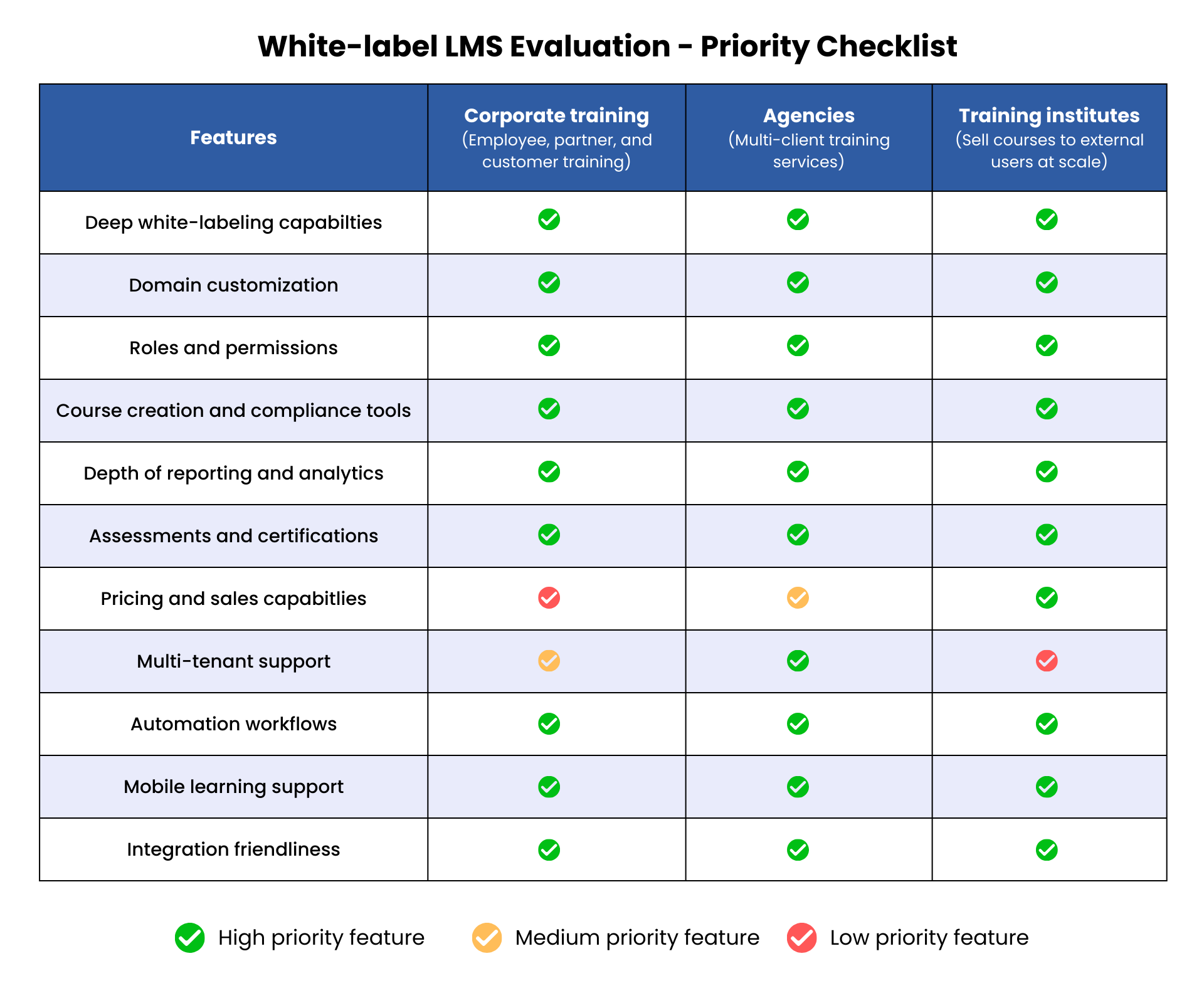
Businesses with LMS needs can be broadly classified into three types.
Training institute
These types of businesses often sell courses to external users. They require an LMS with strong course selling capability, subscription support, certifications, email workflows, and the ability to manage large course libraries without much operational overhead or technical complexities.
For these businesses, the best white-label LMS is the one that can support revenue growth and deliver exceptional learner experience at scale.
Training agencies
Agencies operate like an external training entity, selling a library of courses to multiple businesses. For an agency-like business, a multi-tenant feature might be the core need in your LMS. Brand and portal customization becomes a crucial part of your service offering.
Agencies often need to build new branded portals, manage a centralized content repository, reuse course content across clients, and set up client-level reporting. In such cases, the best white-label LMS is the one that supports comprehensive multi-tenant and branding capabilities.
Corporate training
Businesses come in all sizes and shapes. They have varied needs, especially when it comes to training. Some businesses need an LMS to train new employees and upskill existing teams. On the other hand, an LMS can be used to train customers to improve product adoption and empower channel partners. In these cases, the LMS should support structured onboarding training journeys and integrate with existing systems to track customer retention and partner performances.
11 key features every white-label LMS must support (non-negotiable)
During your white-label LMS platform evaluation process, there are certain features that should be treated as absolute necessities and baseline requirements. These features are the foundations that can impact your brand trust, operational efficiency, and business scalability.
1. White-labeling across the platform
True white labeling should be supported across the platform and not just limited to just adding logo or brand colors. The white-labeled LMS tool should feature extensive customizations to create a learning environment that feels like a uniquely built product tailored to your organization—rather than a generic third-party solution.
This includes consistent branding across learner portals, dashboards, communication emails, learner notifications, and certificates. Consistent branding across different learner touchpoints ensures an improved learning experience and strong brand authority.
2. Domain customization
Domain customization is another crucial area that most LMS buyers overlook. A strong white-label LMS platform should definitely support true domain mapping, not just redirections. True domain mapping greatly helps with building your brand trust, SEO rankings, and long-term business plans.
3. Roles and permissions
Roles and permissions is the most important feature that helps businesses scale their training programs. As your own training program scales, the need for granular level permissions and access controls becomes an absolute necessity. You’ll have to define specific admin permissions, instructor roles, user control controls, and reporting visibility. Without a comprehensive roles and permissions system in place, your training operations can become risky and difficult to scale.
4. Course builder and compliance tools
You may be hosting training programs for employees, onboarding customers, certifying partners, or even running paid courses for external learners all at the same time. This is where the flexibility of course creation capabilities come into play.
Your LMS should help you build structured learning journeys instead of just hosting content. Features like customizable learning paths, prerequisite rules, and role-based course access help you deliver training in a way that actually drives completion and creates tangible learning outcomes. Compliance tools are equally important to ensure training quality in regulated industries or structured certification programs.
5. Depth of reporting and analytics
Reporting is another area you should focus on more when evaluating LMS tools. A simple surface level reporting that showcases course completion percentages and a log of basic learner engagement isn’t enough. Your LMS tool should connect learning to actual business outcomes. A strong white-label LMS platform should provide deep learner engagement analytics, program performance visibility, and support exportable data that can be fed to other systems for further business analysis.
6. Assessments and certifications
If your training programs are tied to revenue or compliance, then assessments and certifications are your core LMS components. A robust assessment module helps you systematically gauge learner comprehension instead of just tracking course completion. Look for flexibility in assessment formats, grading logic, and retake rules. These small details play a major role in deciding the quality of training programs and build a reputation for your certification programs.
Look for tools where certification issuance is deeply integrated with course completion workflows. Customizable certificate templates help reinforce your brand identity, a great feature for organizations selling courses at scale to save time and effort.
7. Pricing and sales capabilities
If your business involves selling courses to external users, then pricing and sales capabilities become a core requirement in your LMS. It isn’t just about setting up a sales page and collecting payments, but about supporting how you can package and sell courses.
If you’re planning to sell courses globally, then the LMS should support region-based pricing, multiple currencies, and multiple payment gateway integrations. This helps reduce payment friction and improves conversion. You should also look for flexibility in pricing models that support one-time payments, subscriptions, and partial payments.
8. Multi-tenant support
The multi-tenant feature in an LMS helps you manage multiple training portals while keeping branding, users, and data separated. This is crucial, especially when you’re serving multiple clients, partners, or business units. Let’s say you run an agency that sells courses to a dozen companies. Instead of creating separate portals, you can create 12 sub-portals from one admin portal. The sub-portals will have individual branding, data autonomy, and reporting.
Using the multi-tenant feature, you can also recreate the same course multiple times from a centralized repository and distribute it across tenants. This is a crucial feature for agencies and businesses with different training use cases to serve multiple clients without proportionally increasing operational effort.
9. Automation workflows
Ideally, a strong white-label LMS platform should reduce repetitive work and help you focus on improving training quality instead of managing tasks manually. Look for automation capabilities that align well with your day-to-day operations.
A practical approach is to map your current training operations and identify areas where you need automation to help your team perform better. Then evaluate whether the LMS can automate those exact workflows. The best platforms aren’t the ones with the longest automation list, but the ones that match your real operational needs.
10. Mobile learning support
Mobile learning is no longer a “nice to have” feature. For many learners, mobile is the most preferred way to access training programs. So, if your LMS system doesn’t offer a strong mobile learning experience, then learner engagement and course completion rates may be impacted. So when evaluating, check whether the mobile app experience is truly optimized or just a scaled-down web version. If consistent branding is crucial to your business, check whether the platform supports white-labeled mobile apps.
11. Integration friendliness
Finally, the depth of third-party integrations determine whether the LMS platform becomes part of your existing business stack or remains a separate system. Strong payment integrations support monetization. CRM integrations support customer lifecycle tracking. Support and marketing integrations help connect training with customer experience workflows.
Additional questions to keep in mind when evaluating a white-label LMS
How strong is the platform migration support?
Migration should happen without any operational outages. So, understand how content and learner data will be moved from your existing system, the scope of assistance offered, and timeline for the migration.
What does implementation actually include?
Double check whether onboarding, setup, or configuration support is included as part of the commercial package or comes at an additional cost.
Are there any lock-in periods or restrictive commercial terms?
Most LMS contracts come with lock-in periods. Thoroughly review contract flexibility, renewal terms, and how disputes are typically handled.
How does pricing change as you scale?
Check whether pricing is tied to learners, courses, features, storage, or transaction-based fees. If so, check the scalability and cost projections based on your expected growth.
What level of technical support is available?
Get a detailed understanding of ticket response times, ways to reach out to tech support channels, and the scope of assistance available during critical situations.
Final thoughts
The bottom line when choosing a white-label LMS is whether it meets your current needs and also supports your long-term business growth. The best white-label LMS isn’t the one that looks the fanciest in a demo, it’s the one that aligns perfectly with your business model, branding strategy, and growth plans.
A strong white-label LMS should become part of your business infrastructure, not just a training tool. If you focus on business outcomes instead of the number of features, you’ll end up choosing a white-label LMS that’s perfect for you.