- HOME
- E-Learning trends
- Transforming the UK hospitality ecosystem through easy, effective training
Transforming the UK hospitality ecosystem through easy, effective training
- Last Updated : November 24, 2025
- 212 Views
- 7 Min Read

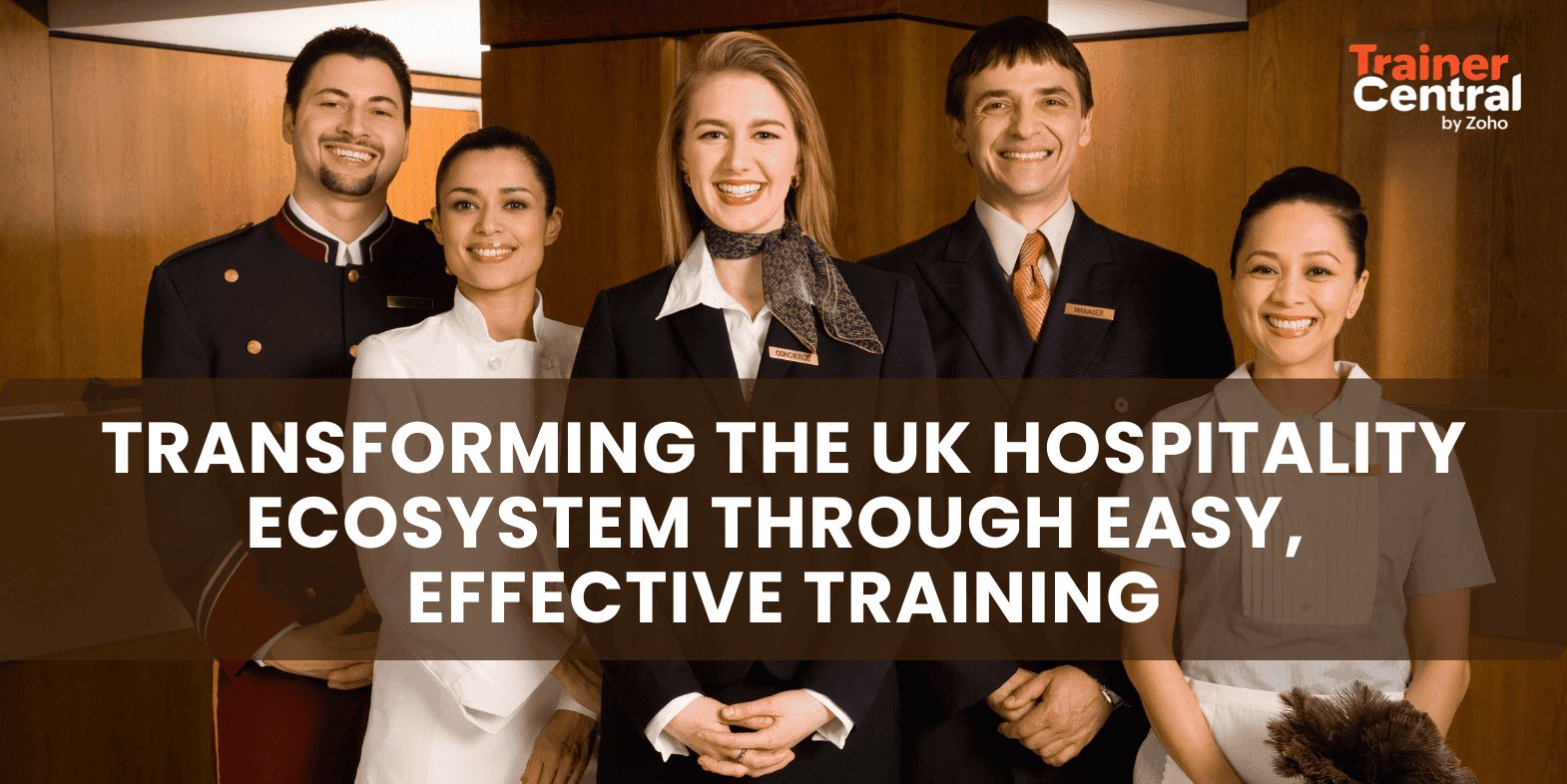
The UK hospitality sector is one of the best in the world, with culturally significant establishments such as pubs, internationally famous night clubs, and food joints.
It’s also one of the largest employment sectors. According to UK Hospitality, the lead trade body for the industry in the UK since 2016, this sector has been the third largest employer in the country.
This also means that a lot of it has had to change since the pandemic. Many businesses have been affected and various business aspects had to be digitised. As an industry with one of the highest churn rates, bringing digital stability to hospitality is a mammoth challenge. People change, seasons change, and hiring and training needs change according to these trends.
The value of training in the hospitality industry
The hospitality industry is based on people, and the core value is service. Training is essential to provide the best service throughout the year, even with high seasonal turnovers. Proper training directly impacts revenue by improving service speed, guest satisfaction, and overall efficiency, while also ensuring that teams stay compliant with food safety, alcohol regulations, and health standards.
Well-trained employees bring business with great service each time. Training ensures that brand identity and standards are maintained by providing a seamless experience to customers.
The training challenge
Maintaining meaningful, consistent training and onboarding standards in an ever-changing industry like hospitality comes with many unique challenges.
- Ensuring and tracking that all of the compliance training is completed before onboarding any new employee, whether they’re manager-level or entry-level. In manual methods, this leads to scattered records, long paper trails, and a difficult time in general when it comes to audits.
- Training seasonal workforces (who sometimes have no background in hospitality), dealing with inconsistency, maintaining standards in re-hiring, and re-training people to maintain delivery standards.
- The pressure to maintain consistent brand experience and compliance even with a changing workforce.
- A lot of establishments still depend on “on-the-job” training methods where a new employee/employees are trained on the floor by other trained employees and managers. This leads to slow service, manual errors, and loss of valuable time for managers.
Depending on traditional training methods while delivering to a digital-savy clientele is a set up for failure. It's like still depending on cash registers in an era of POS systems. As a franchise or a standalone establishment, you may use a stack of PDFs, in-person briefings, and hours of on-the-job training to train, re-train, and onboard your employees.
However, when it comes to updating existing content, making sure that new hires finish their training, and saving managers’ time, the traditional methods fall short.
Digitising training in hospitality: Approaches and tools
Digitising training makes sure that new hires show up to work, not to training. It enables managers to deliver better customer service and solve business challenges rather than spend time training people from scratch. Digital onboarding helps keep track of compliance training and keeps the data in one place that, in turn, helps in audits.
With digital training and onboarding we achieve the following benefits:
New employees complete compliance and brand-standards modules before their first shift. This shortens onboarding time and enables faster delivery of service.
Food safety, fire safety, and workplace conduct modules are completed, certified, signed off on, and kept track of in one digital repository. Digital records of training acknowledgements and policy sign-offs reduce paper trails and compliance risk. It also simplifies audits from the head office or regulators like the Food Standards Agency (FSA).
Making mandatory training for seasonal workers easy and tracking its completion. Making sure that
inconsistent trainees or course skippers don't join the workforce. This cuts down inefficiency, maintains service standards, and makes sure there are no compliance challenges later due to ineffectual training.Preparing new employees to uphold your brand identity becomes much easier. Many pubs, for instance, have rich histories. Sometimes they’re even housed in significant old buildings. The staff need to know these stories for tourists.
Every establishment handles greetings, service, and customer grievances differently, and these details shape its character and set it apart from competitors. That’s why it’s essential to preserve this brand identity across the entire employee chain.
There’s a growing need for a platform that enables teams to build customized training and onboarding programs. These programs must go beyond compliance. They should reflect the company’s culture, values, and brand identity, helping new employees feel prepared and aligned from day one.
That’s exactly where TrainerCentral by Zoho comes in. It’s an all-in-one course creation platform that helps you design tailored programs, track compliance, deliver effective training, streamline onboarding, and support ongoing knowledge sharing all in one place.
This raises a concern of training your seasonal staff in the hospitality business. You may wonder: Why should you invest in training staff that will be there only for a few months and may never return?
Simplifying staff training and seasonal onboarding
With a high attrition rate of 52% according to a CIPD report, the hospitality industry in the UK constantly spends on hiring, training, and recovering from disruptions. One of the reasons for this high churn is viewing any role in the industry as a stopgap and not as a career.
With an established, digitised employee training system for both full-time staff and seasonal hires, hospitality establishments can:
- Create a course once, repurpose it, and update it as and when needed. Save time and money on training. There’s no need to create training resources multiple times.
- Track course compliance for seasonal employees for safety and compliance courses. Make sure your reputation stays spotless.
- Onboard seasonal hires faster. If you hire seasonally every year, then having a course created to onboard these employees streamlines the process, and cuts down on training time and paper trails. Create a refresher course for all of the returning workers so that they’re ready faster.
- Offer certificates on completing these courses. This gives your employees a sense of accomplishment as well as proof of their efforts that they can use in the future. Once they get a compliance training certificate, they can use it for rehire or for their next job.
- Staff training becomes a continuous practice instead of an one-time process boosting ROI.
- Use the training platform for building employee community. Share personal experiences, ratings, menu changes, and other updates. This helps with employee engagement or continuous learning from each other.
- The platform can also be used for knowledge transfer. When an experienced employee leaves, they can contribute their learnings in the form of a digital course or video for the next employee in the same role. Experienced staff know regular customers, the establishment’s culture, and its way of handling things. This way, when they leave, the institutional knowledge doesn't leave with them. It takes less time and experience for the next person to learn directly from their former colleague.
Provide upskilling training to frontline workers, managers, chefs, and other staff, making their job a career in hospitality and not just a stopgap. This decreases the churn rate and keeps trained employees for the longer run.

Centralised training to drive brand consistency across franchise
Franchisees need brand consistency for employee training and standardised partner onboarding. Every service needs to maintain the same brand standard, each outlet needs to follow fixed protocols, and every partner needs to abide by the same guidelines resulting in a seamless experience for the customers irrespective of geographical location.
A centralised system for employee training and franchise partner onboarding keeps things together and streamlined.
TrainerCentral is a scalable platform offering multi-location control with analytics and a centralised system for training and onboarding partners and employees. You can create separate training modules for franchise owners, outlet managers, and new branches. It also acts as a centralised repository for brand guidelines, operations, and customer experience.
That’s exactly what TrainerCentral offers with white-labelling capabilities that ensure brand consistency across the website and the app, making sure the brand experience remains the same for both employees and partners.
Training to empower consultants and the vendor ecosystem
Consultants and vendors are an important part of the UK hospitality industry ecosystem. This industry heavily relies on consultants to bridge restaurants, hotels, and solution providers, like POS system providers, sustainable packaging solutions, and tech vendors.
Training works both ways for these scenarios.
- Hotels and restaurants need training courses to onboard vendors and consultants, and to discuss guidelines, company policies, and regulations.
- Vendors and consultants need customer training to demonstrate tools and understand payment and communication structures.
- Sustainability-focused vendors need courses to educate customer restaurants and hotels on sustainability compliance, recycling best practices, and eco-friendly operations. For example, a waste management vendor needs to train hotels on how to segregate their waste.
A centralised, digitised, customized training for the hospitality ecosystem
The UK hospitality industry is a complicated, dynamic ecosystem of multiple moving pieces. A simple bundle of training collaterals or one-size-fits-all training packages, while convenient, doesn’t complement brand voice, customized needs of different businesses, or unique practices by various establishments.
The interconnected network of restaurants, hotels, vendors, and franchise partners need something branded, customizable, and, most importantly, scalable to drive operational excellence, compliance, and sustainability goals.
Compliance training doesn’t need to be just a bundle of PDFs. It can also be taught through short videos mapping the floor of restaurants. Fire safety can be taught by quizzes with photos of where to locate the nearest fire extinguisher on the floor. Personalised learning is more engaging. It makes sure that people learn in the context of their workplace, leading to a higher number of completed courses, centralised records of compliance, and a workforce that delivers excellence every time.
Final thoughts
Digitising training and onboarding is a step towards bringing the dynamic ecosystem under a comprehensive, seamless system that leads to saving time, faster execution, and a direct positive impact on revenue.