- HOME
- E-Learning trends
- White-label LMS explained: What it is, how to choose one, and use cases
White-label LMS explained: What it is, how to choose one, and use cases
- Last Updated : February 18, 2026
- 528 Views
- 8 Min Read

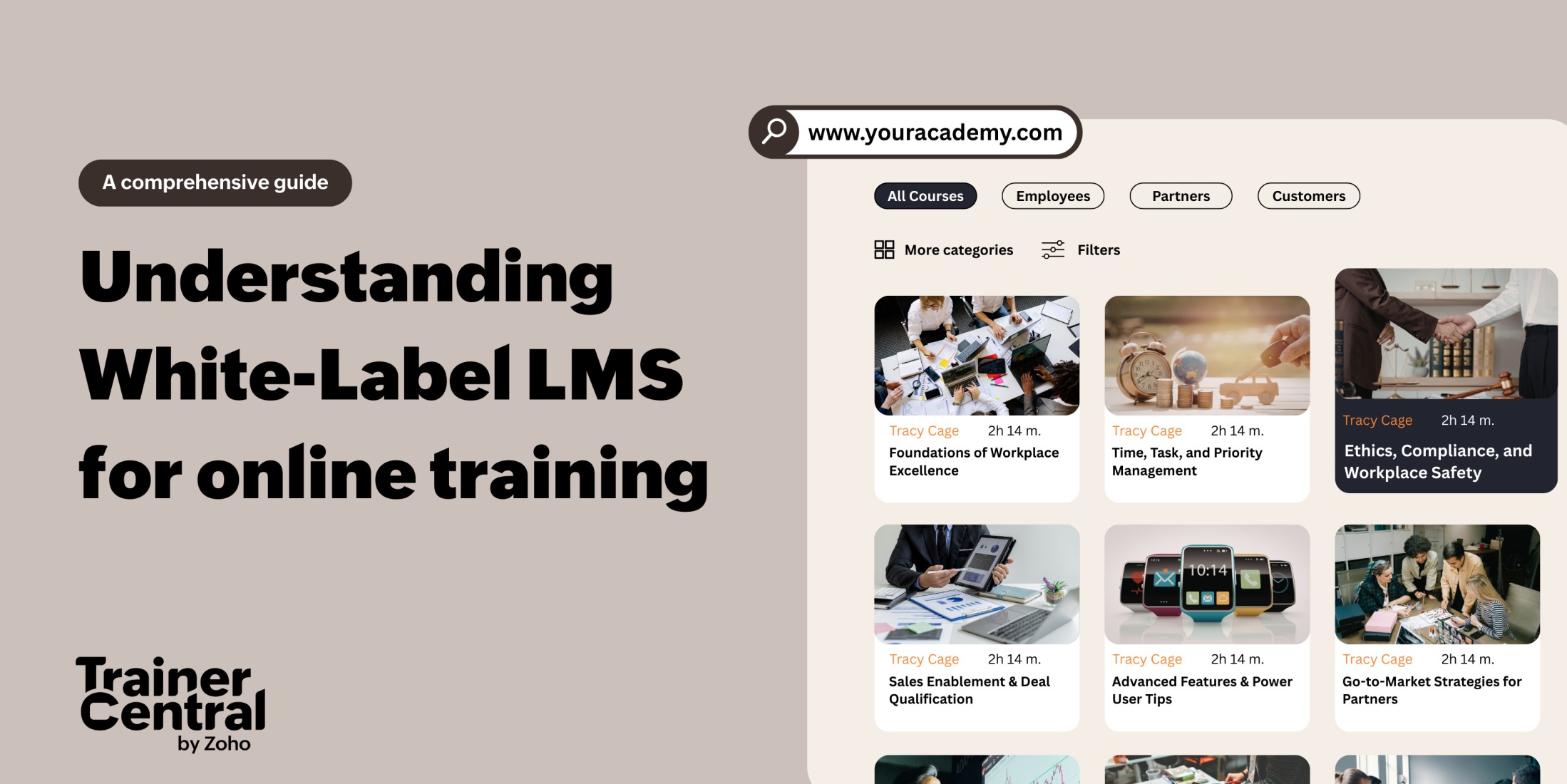
White labeling is simply when a company or a brand develops a product, and another company rebrands and sells it as their own. White-labeling is used in many industries, such as health and beauty, food and beverages, e-commerce, and even in SaaS.
But you might be wondering: If multiple brands use the same core product, how can they differentiate themselves?
These white-labeled brands differentiate through their brand narratives, the audience they target, the type of support they offer, and even through their pricing plans and compliance.
The same works for an LMS, too. Whatever online courses or training programs you sell, as an expert you would rather focus on teaching learners than building an LMS from scratch or juggling between multiple tools.
In this article, we’ll look at what a white-label LMS is, the features they posses, and their use-cases across industries. We’ll also provide a quick checklist on things to look out for when choosing a white-label LMS.
What is a white-label learning management system?
A white-label LMS is an online training platform that’s built by one company but rebranded and used by another. The LMS supports deeper customization and branding so that from a learners’ point of view, it completely looks like your own brand.
You can replace the LMS vendor’s logo with yours, change the color theme and font style, and can even use your own URL. This lets you deliver a customized learning experience for your employees, students, and clients without developing an LMS from scratch.
It should be noted that all white-label platforms are customizable LMSs, but not the other way around. Some LMSs allow limited theming, such as color changes or simple logo changes. However, a true white-label LMS goes further by removing all vendor branding, even in emails, certificates, and domains, making the learner’s entire experience feel like your own branded portal.
White-label LMS vs. Customizable LMS
Many LMS vendors often promote that their platform is customizable. But this doesn’t mean they’re white-label friendly. Here’s how you can tell the difference.
A standard customizable LMS may let you adjust layouts or add a logo, but it often still shows the vendor’s name somewhere, like in the learners’ interface, or it could use its own domain. Example: www.yourbrandname.theirplatform.com.
However, a truly white-label LMS can be rebranded completely from replacing the vendor’s logo, having your own subdomain, and even publishing a mobile app under your brand’s name. So, white label means your brand alone is front and center, whereas a merely customizable LMS may leave visible vendor traces.
What white-label LMS usually includes
A white label LMS usually covers branding, domain, and user experience. Here’s what you can do with the LMS to make it uniquely yours.
Personalize the interface: Whether it’s a learner-facing interface or your trainer dashboard, you can customize the logo, color theme, font size, and style to match your brand. Several platforms, such as TrainerCentral and TalentLMS, let you do all of the customization you need.
Deliver training under a custom domain: Learners can access your learning materials under your website address that doesn’t have a vendor domain. A true white-label LMS allows you to map your existing domain, so that your learners can visit training.yourcompany.com instead of something like yourcompany.theirplatform.com. This will build brand credibility and boost SEO because the learning and website visits happen on your own domain.
Broadcast-branded communications: All learner-facing notifications (emails, reminders, certificates) carry your branding. TrainerCentral’s white-label LMS allows you to map your personal or company’s email address to send all email notifications to learners and clients.
Provide custom certificates: Completion certificates can also be fully customized to reflect your logo, colors, and signatures. You can upload your own designs or choose from pre-built templates in the platform, and add other required dynamic fields.
Publish branded learner mobile app: Some platforms offer a white-label mobile app that learners can download from app stores under your brand name. Several online training platforms, such as TrainerCentral, TalentLMS and iSpring, let you create and publish a branded mobile app on Google Play or Apple’s App Store.
Use cases of white-label LMS
A white-label LMS can be used by any organization in any industry catering to several different use cases.
Corporate training and employee onboarding: When companies hire and train new employees, or onboard partners and affiliates, they would prefer offering a learning experience that reflects their brand instead of redirecting learners to a completely different-looking portal. Using a white-label LMS, the training portal can be fully customized so that onboarding courses (videos, quizzes, webinars) feel like part of the company’s environment.
Training institutes and educational providers: Organizations that sell instructor-led or cohort-based courses (including universities, bootcamps, and vocational schools) use white-label LMS to build trust. Large enterprises and educational institutions are among the primary users of white-label LMS platforms. By delivering courses on a branded portal, these providers reinforce their brand’s credibility. It lets them focus on curriculum and student success, rather than fiddling with platform building.
Agencies and B2B training companies: Consulting firms, digital agencies, or resellers that develop training for clients often want to rebrand the LMS as their own offering. A white-label platform allows agencies to sell the training solution under their own name, giving the end client (the company) a seamless learning experience. This is common in fields like HR training, safety certification, or professional development, where agencies need to demonstrate ownership of content for compliance purposes.
Franchises and multi-location businesses: Companies (like fast food chains, salons, restaurants, and other point of service centers) with multiple branches across geography or franchises can use a white-label LMS to standardize training across those locations. By training all of their employees and franchisees on a single branded portal, the company can ensure consistency in onboarding and training.
Customer education and partner academies: B2B SaaS firms, hardware vendors, and professional services companies often create customer training programs and courses containing product tutorials, certifications, and more. This will reduce the load on the customer-facing teams by answering frequently asked questions and details through the program. A white-label LMS lets you deliver these customer education courses under the product or company brand.
White-label online learning platform vs. marketplaces
Sometimes, when creating online courses or training programs, you may need to decide whether to host your courses on your own white-label platform, or rely on a third-party marketplace (like Udemy or Coursera). There are a few differences in terms of ownership, branding, and control.
Ownership (domain, SEO, audience): With a white-label LMS, you fully own the learning portal. All of the web traffic goes to your website, which improves the SEO for your brand. But in a marketplace, you don’t own the audience or the platform. They offer instant access to millions of potential learners, but they charge significant revenue shares (revenue commissions) and keep all of the traffic to your course under their name. Organic searches for your course content will lead to the marketplace, not you. By hosting courses on your own site, you can retain the SEO benefits and other learner data such as email lists and analytics.
Read: Udemy vs. online course platforms
Experience continuity: A white-label LMS provides a seamless brand experience. Learners remain in your branded environment from start to finish. But marketplaces use standardized templates and display their own branding. So when you try to promote a training program on your website, and learners navigate from your website to course, they feel the discontinuity. However, on your own LMS, there’s no drastic transition. The login page, course player, and certificate all match your branding. This continuity can improve trust and engagement.
Data and reporting control: On a white-label LMS, you get full access to learner data and analytics. You can generate custom reports based on course completions, learner progress, learner geography, and more as and when needed. You can send learners personalized communication based on your preferred criteria. Marketplaces usually provide only limited insights. By owning the platform, you can measure exactly what you need (login behavior, quiz scores, cohort progress) and integrate it with your other systems.
Avoid these common mistakes when choosing a white-label e-learning platform
Even with all of these benefits, there are some pitfalls when choosing a white-label LMS.
Trading features for looks: Don’t fall for an LMS that looks branded but lacks basic functionality. Some LMSs focus just on branding and often skip the foundational learning tools. For instance, you can replace the logo and change colors, but miss robust features like assignments, assessments, course management, and reporting features. So, ensure the white-label LMS still offers full course creation, assessment, and reporting capabilities, not just superficial theming.
No governance or controls: Another common oversight is neglecting admin controls. If the LMS allows anyone in the academy publish a course without any approval or guardrails, you may end up with unauthorized course access or data-sharing issues. Ensure that your LMS has the ability to set clear roles and permissions, such as admin, trainer, and course creators, and also has proper course approval workflows.
Branding without an engagement strategy: Simply customizing the logo and theme of your online academy won’t make your training effective. Don’t focus just on branding and end up ignoring your course quality. If the quality of your training content is weak, even a customized learning experience won’t prevent high dropout rates.
Hidden costs for “extra” features: When choosing a white-label LMS, carefully check the pricing model. Some charge extra for each white-label feature. Maybe custom domain comes as a separate add-on, branded mobile apps come separately, and so on. Don’t assume white-label means it’s all-inclusive. Always clarify what will be available in your plan. Can you add unlimited domains? Is there a cost for extra sub-accounts, or is there free storage? Read the pricing plan thoroughly or speak with the salesperson so you’re not surprised by add-on fees after committing to a platform.
Being aware of these missteps and ensuring you prioritize both branding and functionality will help you choose a white-label LMS that truly serves your needs.
Evaluation checklist for a white-label LMS
When evaluating a white-label LMS, look for these features:
Full branding control: Can you replace logos, colors, fonts, and themes so the portal matches your brand?
Custom domain support: Does the LMS’s pricing plan allow you to map your own URL or subdomain, or do you need an add-on package?
Branded emails: Can system emails, such as enrollments and notifications, be sent from your email address with your own branding?
White-label certificates: Are completion certificates fully personalized with your logo, design, and custom fields?
Course and assessment tools: Does the platform offer robust course creation tools like assessments, course progress trackers, and live classrooms, rather than just a branded interface?
User roles and permissions: Can you control who publishes courses and who has access to what actions?
Mobile app: Can you build a fully branded iOS/Android app under your name?
Analytics and reporting: Does the LMS have access to detailed learner data such as progress, completion, and engagement?
Integrations: Can the LMS integrate with your existing SSO, HRMS, CRM, or other business tools?
Transparent pricing: Is the pricing clear (e.g., fixed fee vs. revenue share)? Look out for hidden costs like multi-portal, extra users, and storage.
Read: How to evaluate and choose a White-label LMS for your business
Wrapping up
A white-label LMS gives you control over your brand, your learners, and your data. If online training is an important part of what you do, you don’t want learners and clients to feel like they’re learning from someone else’s platform.
Be it onboarding employees, partners, or franchisees; educating customers; or selling courses to clients, a white-label LMS allows you to establish your course content under your own brand.
White-labeling isn’t just about changing the logo and colors. A true white-label LMS should combine the required learning features, clear admin controls, and pricing that’s easy to understand.