- HOME
- Building a business
- How to presell your online course and create demand before your launch
How to presell your online course and create demand before your launch
- Last Updated : July 16, 2025
- 324 Views
- 7 Min Read

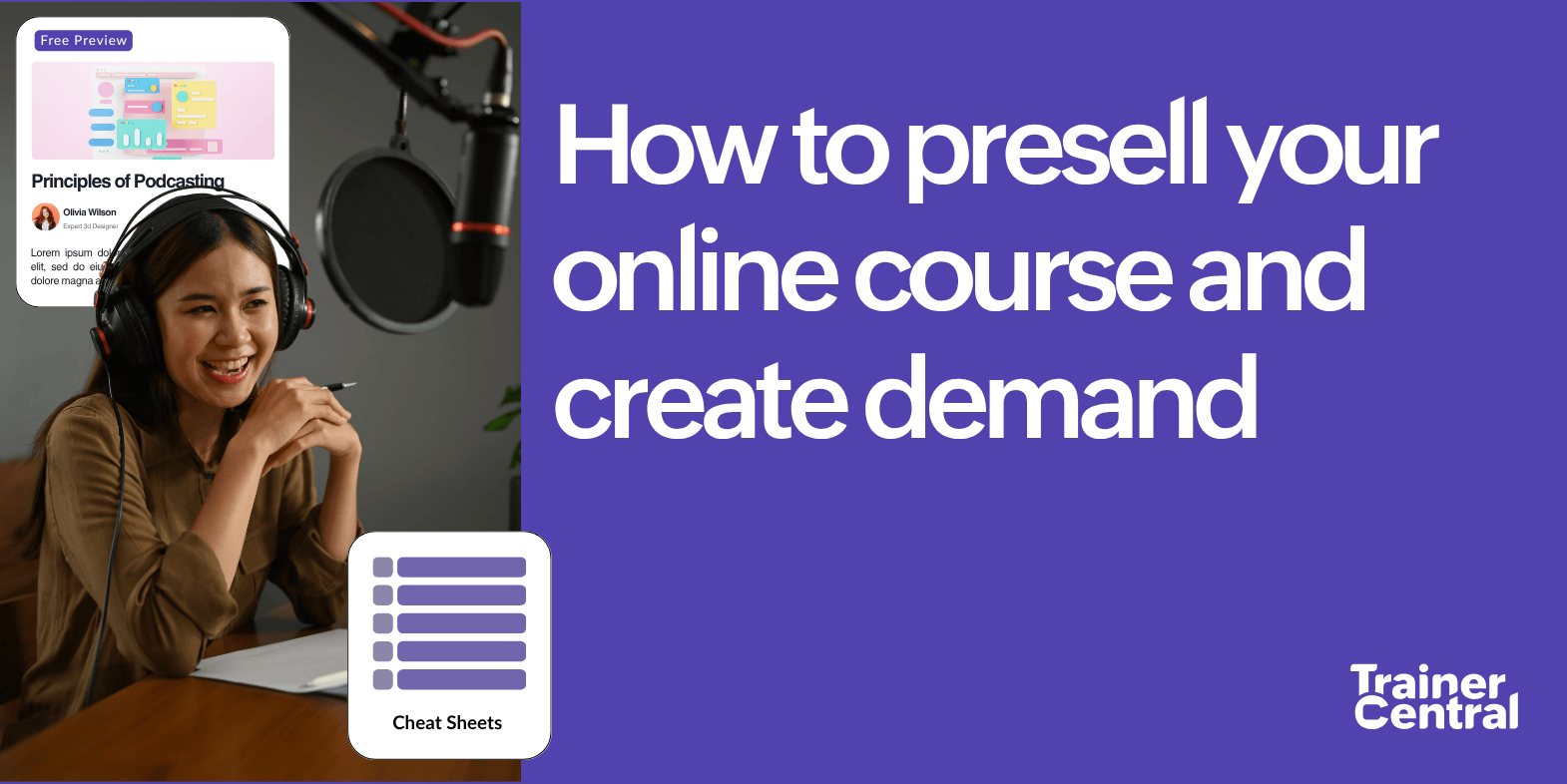
You don’t need a fully finished online course to build excitement around it. Preselling is about sharing a glimpse of what your course offers and who will benefit from it.
Whether it’s through a short preview lesson, a live session/webinar, or a simple worksheet to spark interest and build a community of learners early on, preselling is a powerful way to build momentum, attract the right audience, and shape your online course based on real insights.
In this blog post, let's look at what preselling is, why you must presell your online courses, the different formats to use, and how you can distribute them.
What is preselling?
Preselling is the process of selling your online course before it's fully created or launched. You invite your potential learners to buy early, often for free or at a discount, in exchange for early access, special downloadables, or the opportunity to be part of a learning community.
The benefits of preselling online courses
1. It generates revenue before you build your course.
This may not always be the case, but preselling your course by offering a small piece of information or a downloadable can help you earn money you can use to fund equipment and tools to create your online course, or to hire freelance editors and designers.
2. It builds a community for your course.
If your presell material is valuable, you can spark your prospective learners’ interest and form a community around your online course. Having a learning community helps you run your ideas past them, gain insights, and tailor your course accordingly.
3. It motivates you to complete your final product.
Instead of feeling lost about what course materials to include or what the evaluation and teaching strategy should be, preselling gives you a structured and proven path to follow—not based on assumptions, but on real prospect insights. This will motivate you to finish your course instead of giving up.
4. You can test your pricing and positioning.
When you presell, you get the flexibility to experiment with different pricing for your online course. You’ll also gain a clear understanding of your learners' goals, helping you craft the messaging around your course more effectively.
5. It boosts conversion at launch.
When you already have a community of prospective learners who like your content, it’s easier to sell your completed product to them instead of running marketing campaigns and searching for a new audience. You can also collect testimonials from your existing customers and use them for your promotional activities.
How do you presell your online course?
Try offering small micro-MVPs to gauge interest. A micro-MVP (Minimum Viable Product) is the simplest, fastest version of your course idea that you can share with prospect learners to test if there’s real interest for the topic chosen, before you build the full course.
For example, offer a free PDF or a mini email course to see if people sign up. In other words, go lean and give learners a taste (like a cheat sheet or short video) that shows how valuable your course will be and encourages them to take action, such as following you or joining your learning community.
You can offer your micro-MVPs in various formats, including:
Cheat sheets (PDFs)
A one-page guide summarizing the core framework of your online course is a fast, high-value preview and part of many course funnels. Cheat sheets compress your core framework into a format that’s quick to review and easy to apply, making them excellent teasers for a full course.
You can even brand it as a PDF and add a lead magnet to collect emails, which you can later use during marketing.
Teaser video
A one- to two-minute promo outlines what learners will gain. Post it where your audience is (e.g., YouTube, Instagram, LinkedIn) with a link to sign up to your course. Course creators often share short teaser videos with their followers to drive interest and traffic.
Email mini-course
A brief email series (three to five days) delivers quick wins and builds your list. An email mini-course is easy to set up with any email provider, and it can be free while teaching a core concept.
It’s both a course MVP and a sales funnel. People consume real value in their inbox, and you get to see who engages.
Live workshops
This is a great way to engage your prospective learners’ interest in real time. You can schedule a webinar that covers who your online course is for, what it includes, and what learners can gain from taking it.
You can even share practical and noteworthy tips that build trust and position you as a thought leader.
Sample or preview lesson
This is similar to a live workshop. Simply offer a lesson or module from your online course that covers a core topic for free. The goal is to help learners take away useful information without giving away too much.
This allows you to showcase your course quality and even gather feedback to refine your offerings.
Quiz or self-assessment
Offer a short quiz that helps prospective learners identify where they stand and points them toward your course as the solution. This is a great way for learners to evaluate themselves, and they’ll naturally seek a solution that offers genuine value.
Where and how to distribute your MVPs
Once you have a micro-MVP ready, get it in front of your potential learners. Try multiple channels, including:
- Forums and communities: Post in forums that are relevant to your course topic. Subreddits, Quora, LinkedIn or Facebook groups, and other professional groups are great for sharing your idea or asking for feedback. You can even ask questions or run a quick poll there.
- Social media: Announce your micro-MVP on your social media platforms like LinkedIn or Instagram. Put a clear call-to-action link in your Instagram bio leading to your signup page. Share engaging posts (or stories) about the problem your course solves and invite comments or DMs. On LinkedIn, you can write a post or article pitching the idea and asking if others would join. If you're just starting out, gaining engagement on social media is hard. If your budget allows, you can try boosting your posts, too.
- Your network: If you already have an email list, use your email signature or newsletter to link the micro-MVP. Consider personal channels like WhatsApp, Discord, or Slack groups where your audience is. A simple message to friends or colleagues (“Check out this free course preview!”) can yield quick interest.
- Content platforms: If you have a blog, YouTube channel, or podcast, mention your upcoming course and link to the opt-in. Embed the cheat sheet link in a relevant blog post or in video descriptions. Use your own website and social profiles to link back to the sales page and broadcast it in any content you create.
The key is to expose your offerings wherever your target audience looks for help. Don’t just post once. Share repeatedly but naturally (i.e., in different posts or stories). Each share is an opportunity for someone to sign up or ask questions.
How to track interest
The success metrics depend on the distribution format you chose. Some common metrics include:
- Email sign-ups: Count how many people register for the free mini-course, download the cheat sheet, or join your waitlist. This is a direct measure of demand.
- Click-throughs: Use trackable links (UTMs or shorteners) from your social posts and emails. Measure what percentage of viewers click to learn more.
- Engagement: Note comments, “likes,” shares, and especially direct messages. Each DM or comment asking “tell me more” is an indicator of interest.
- Live webinar or preview course signups: Track how many people register for your promotional webinar or free course module. This is a direct indicator of interest and demand for your course.
Set a time frame (e.g., one to two weeks) and tally your results. Give it a few weeks to gauge how your promotions are doing and keep a close eye on your achievements against your success metrics.
If you set a goal (say X sign-ups or Y% CTR), compare your actual numbers. If targets are hit or exceeded, that’s a green light. If not, gather feedback from those who did respond and refine your idea or outreach and then test again.
Benchmarks to look out for
Benchmarks vary by channel, but here are a few ballpark figures:
- Landing page sign-up rate: Studies have found that the top 25% convert at least 5.3%, and the top 10% of pages convert nearly 11.45% of traffic into sign-ups. If you get more than a 5% sign-up rate, you’re doing better than average.
- Email click-through: The average email CTR across industries is only 2.6%. So if 3% to 5% (or even more) of your email recipients click through, that’s a good number. If your newsletter or announcement emails are getting higher-than-average engagement, that signals strong interest.
- Social engagement: There’s no fixed standard for tracking social media engagement. But when dozens of people reach out relative to your audience size, you can say your effort worked out. For instance, if 1% to 3% of your followers send a DM or leave a positive comment on Instagram, it’s a strong sign that your content is resonating with them.
Overall, good engagement is anything that feels higher than you’d expect from cold outreach. Even a small pilot test, say 50 to 100 targeted invitations that yield 10 to 20 sign-ups or several enthusiastic messages, can justify building the full course.
Wrapping up
By using these micro-MVPs and tracking real responses, you can presell your online course to the public with minimal risk. You’ll either confirm that people want what you plan to teach, or learn what to tweak before you invest heavily. Test first, presell next, and then build. That’s the lean way to launch an online course with confidence.You don’t need a fully finished online course to build excitement around it. Preselling is about sharing a glimpse of what your course offers and who will benefit from it.
Whether it’s through a short preview lesson, a live session/webinar, or a simple worksheet to spark interest and build a community of learners early on, preselling is a powerful way to build momentum, attract the right audience, and shape your online course based on real insights.
In this blog post, let's look at what preselling is, why you must presell your online courses, the different formats to use, and how you can distribute them.