- HOME
- Building a business
- Microlearning and multi-device support: The way forward for enterprise L&D teams?
Microlearning and multi-device support: The way forward for enterprise L&D teams?
- Last Updated : July 16, 2026
- 88 Views
- 7 Min Read
When was the last time you genuinely enjoyed completing a mandatory training course at work? For most employees, the answer is probably never. Mandatory employee training programs often feel like a chore. It's possible that the only reason there are any course completions at all is because they’re a requirement. Remove the mandate, and the number of enrollments dramatically drops. That’s not to say there aren’t employees who take these programs out of genuine interest, but they tend to be few and far between.
There’s also no escaping the fact that mandatory workplace training and upskilling programs can sometimes act as an additional burden on top of an employee’s existing task list. In most cases, an employee simply may not have the bandwidth to take on a lengthy and complicated course with excessive training lectures and soulless text-based lessons.
When your training programs are drawn out and complex, you also run the risk of employees simply skimming through them because they’re forced to, meaning they’re not really deriving any meaningful or actionable outcomes from your current approach to L&D. According to Gallup, only one in ten employees strongly agree that compliance training changes how they do their work, highlighting the gap between training completion and meaningful behavioral change.
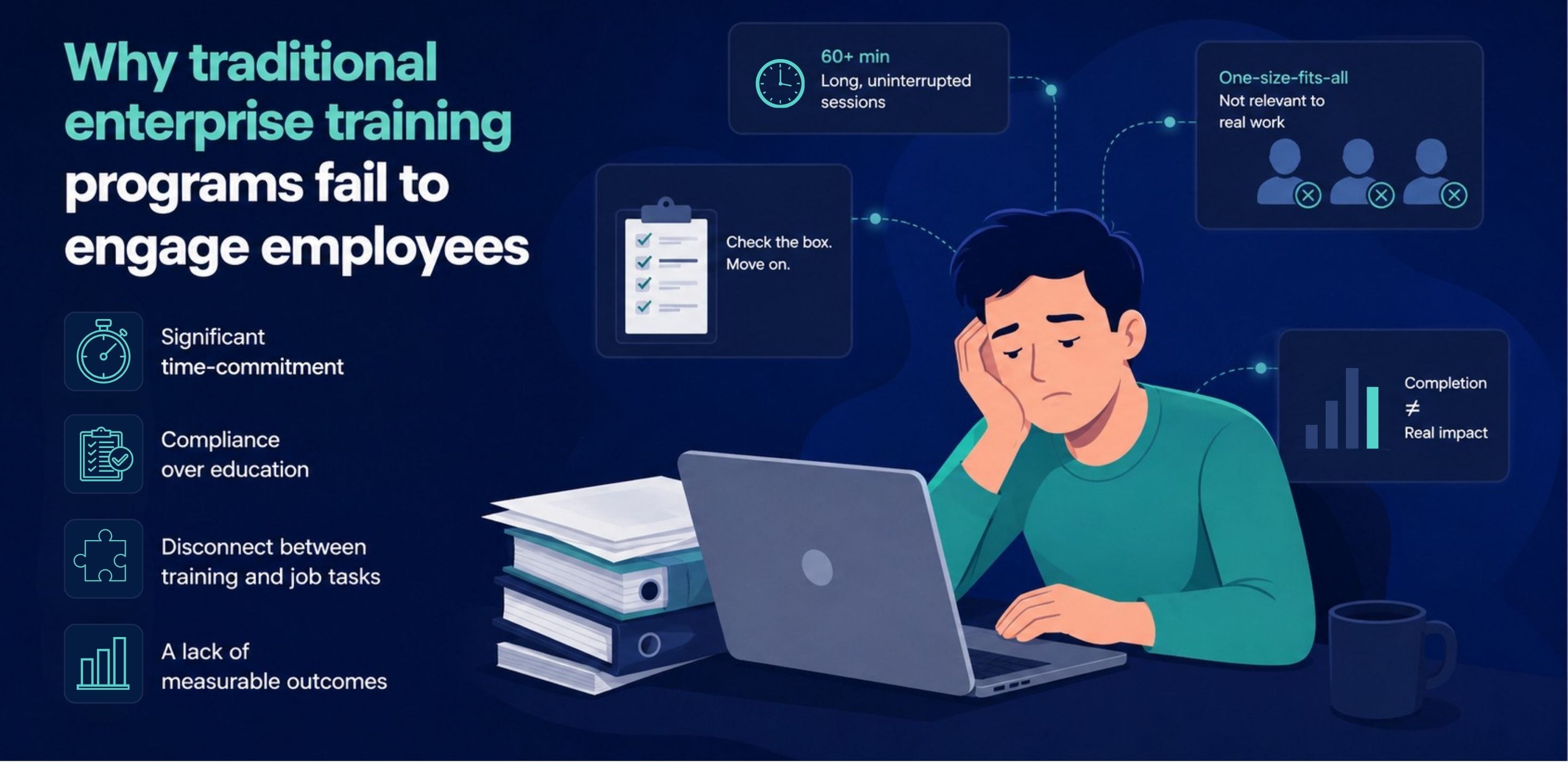
Why traditional enterprise training programs fail to engage employees
1. Significant time-commitment
Traditional training programs are designed as long-form learning experiences, and they demand a significant commitment. Facing a set of lengthy lectures, PDFs, and other text-based material can feel like yet another headache for your employees, especially when they’re already swamped with work. So when training feels like it’s competing with an employee’s daily responsibilities, it’s often deprioritized, increasing the likelihood that learners either disengage or fail to complete the course altogether. In fact, according to LinkedIn’s 2025 Workplace Learning Report, employees cite lack of time as a major obstacle to learning and career development.
2. Compliance over education
Training is often treated as a compliance exercise rather than a learning experience. This is especially true for organization-wide compliance training that focuses on privacy, company policy, health and safety, and culture. When the driving force behind the creation of a training program isn’t a desire to educate, but to simply check off an item from an organizational to-do list, it’s unrealistic to expect it to be a quality product. If the organization treats compliance training as a checklist item, you can bet the employees also see it the same way.
3. Disconnect between the training material and actual job tasks
If your organization has opted for a one-size-fits-all approach to employee training, your workforce has to deal with highly generic training material that may not have total relevance to their immediate responsibilities. Different roles and departments face different challenges, and failing to account for this by not providing relevant, contextualized learning material is a significant factor contributing to employee disengagement.
When employees struggle to see how a training program applies to their day-to-day work, they’re far less likely to view it as a worthwhile investment of their time and attention. For example, while both sales and marketing teams may need privacy and compliance training, the way they interact with customer data can differ significantly. Training programs that acknowledge these differences and provide relevant examples and scenarios are far more likely to resonate with employees than a generic, one-size-fits-all course.
4. A lack of measurable outcomes
Many organizations use course completion rates as the primary indicator for success. While completion rates do provide you with insight into employee participation, course completion alone doesn’t necessarily mean an employee has understood, retained, or applied the information they gleaned from the course. An employee could sit through every module, pass every assessment, and still not see it translate into real-world outcomes.
So what can enterprises do about this?
While traditional training programs can be effective, it’s clear that there’s plenty of room for improvement. When an employee has a large list of responsibilities to deal with, having to complete a dry, drawn out, and complicated course is the last thing they need.
As we’ve already seen, traditional approaches to employee training are becoming increasingly incompatible with the realities of modern work. For the courses to be effective, organizations should aim to simplify their training programs.
The traditional long-form approach to training requires employees to dedicate long periods of uninterrupted focus on a single topic. But the reality is that modern work environments are filled with meetings, emails, messages, and constant interruptions to an employee’s natural workflow. Microsoft’s World Trend Index Special Report found that employees are interrupted approximately every two minutes during the workday, making sustained attention increasingly difficult to maintain.
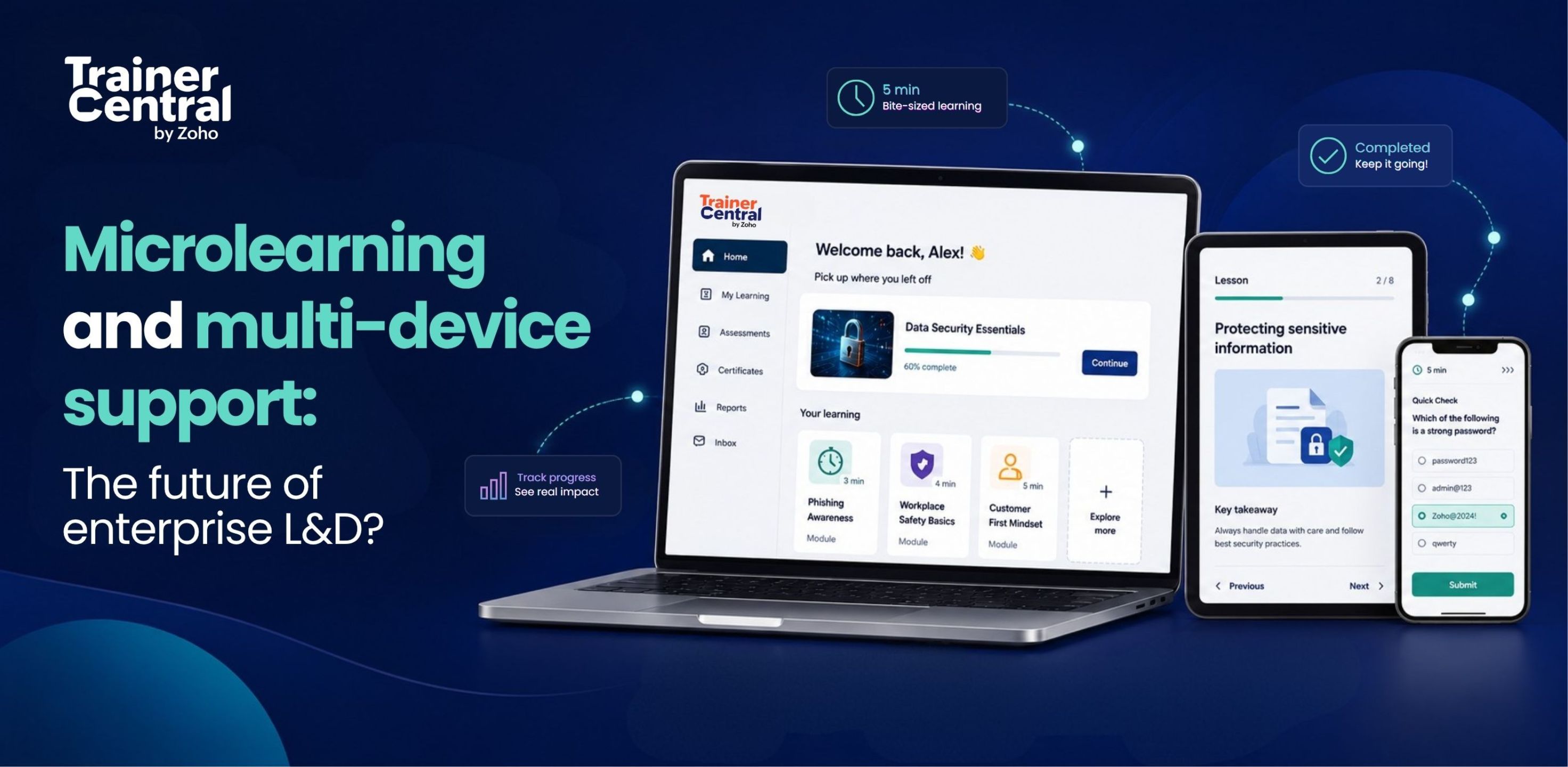
Instead of forcing employees to adjust and plan their schedule around the training program, L&D teams should focus on building flexible learning experiences that can easily fit into an employee’s workday. This is particularly important for organizations that rely on learning management systems (LMS) to deliver training at scale. While LMS platforms make it easier to distribute and manage training programs, the learning experience itself still needs to be designed with employee engagement and accessibility in mind. This is where microlearning and multi-device support come in.
Shrinking it down
Microlearning allows you to condense otherwise lengthy training material into units that are smaller, more specific, and easier to absorb. With microlearning, an employee receives information in short, digestible chunks as opposed to long and granular video lectures that can literally last hours. What once required a single two-hour training session can now be delivered as a series of ten-minute, purpose-built learning modules. The reality is, very few people have the time, patience, attention span, and willingness to deal with an extensive training program.
What does microlearning offer the modern enterprise employee?
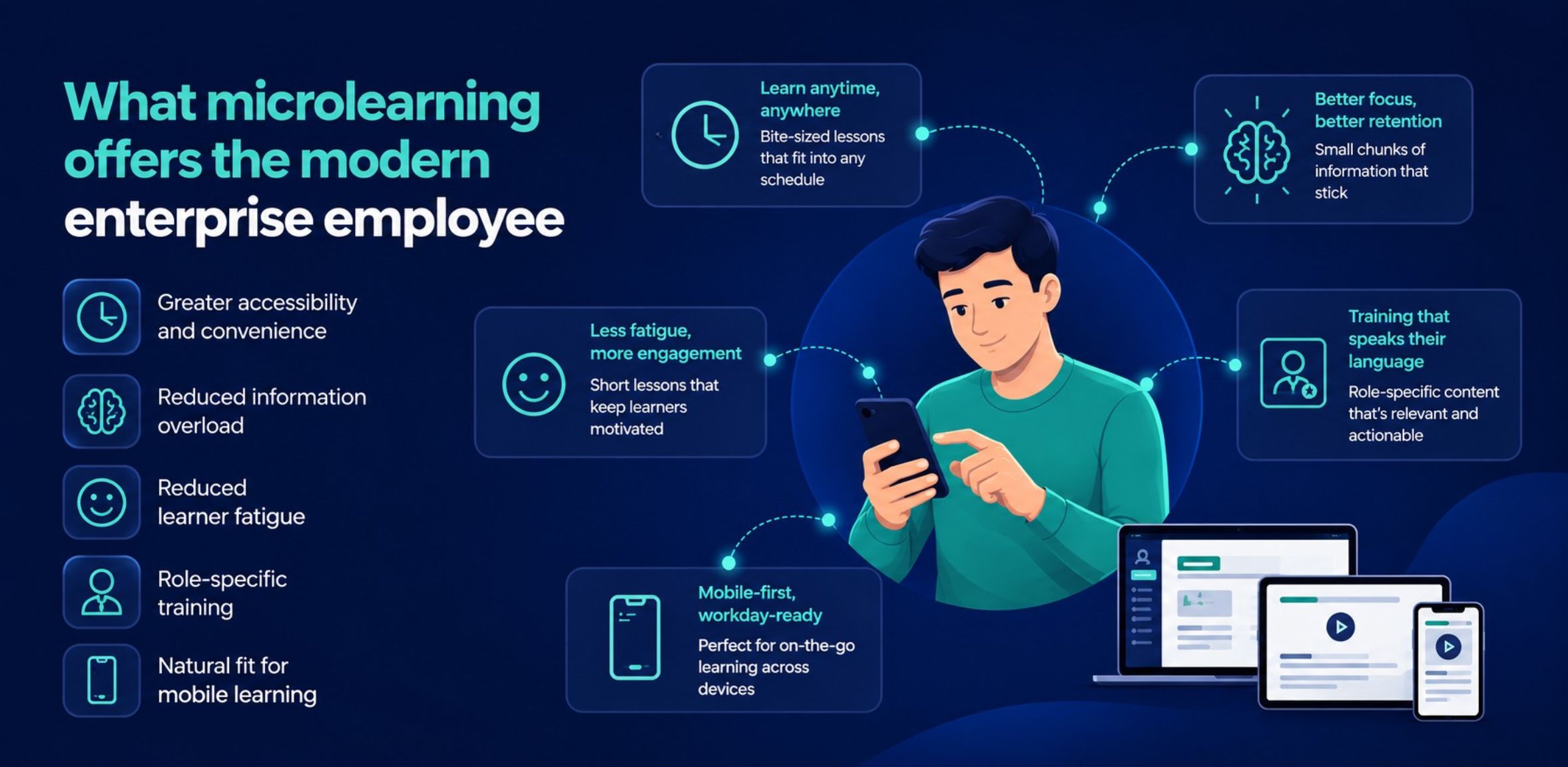
1. Greater accessibility and convenience
Because the training material is now short and condensed, an employee no longer has to invest a significant amount of their time into the course. These bite-sized lessons can be easily viewed by an employee at any time and lend themselves perfectly to being completed during downtime.
Your employees don’t have to dedicate an hour of their time to the course, but they can quickly complete a lesson and get back to their work. They’re far more likely to be invested in the course if it fits within their existing schedule effortlessly and with minimal disruption. Microlearning also allows for just-in-time learning, where employees can access training modules whenever needed.
2. Reduced information overload
In traditional long-form training, large volumes of information are often delivered in a single sitting, making it harder for learners to retain key concepts after the session ends. Microlearning helps counter this by spacing learning into smaller, focused units that are easier to process, recall, and reinforce over time. Because each module focuses on a single idea, employees are less likely to feel overwhelmed by information overload, making it easier to retain what they learn and apply it in real-world scenarios.
3. Reduced learner fatigue
By reducing the scope of individual lessons, you’re reducing the chances of employees feeling overwhelmed by the sheer volume of information they’re expected to absorb. These smaller lessons are far easier to process and understand. After all, being asked to complete a two-hour training course can feel like a daunting task to an employee on top of their existing workload. A short five-minute lesson, on the other hand, feels far more doable and can often be completed during a break or between tasks. This makes employees more likely to engage with the material rather than postpone it or rush through it simply to reach the end.
4. Role-specific training
Microlearning allows you to create short, targeted, and contextualized lessons tailored towards specific teams or job roles. When an employee can clearly see how a particular lesson applies to their role, they’re far more likely to pay attention and ultimately put into practice what they’ve learned.
5. Natural fit for mobile learning
Microlearning and mobile learning are a natural pairing. The short-form nature of these lessons makes them particularly well suited to mobile devices like tablets and phones. Unlike traditional training programs that often require employees to sit down and dedicate a significant amount of time to learning, microlearning allows them to engage with training in shorter, more flexible sessions.
Whether it’s watching a five-minute video between meetings, reading through a short instructional document while traveling, or brushing up on a topic before a customer interaction, employees can access learning when it’s most relevant and convenient. This flexibility makes training feel less like a disruption to the workday and more like a natural part of it.
When paired with seamless multi-device support, mobile-friendly microlearning becomes even more powerful, allowing employees to switch between devices and continue learning wherever they are.
Seamless multi-device support: An enhanced learner experience
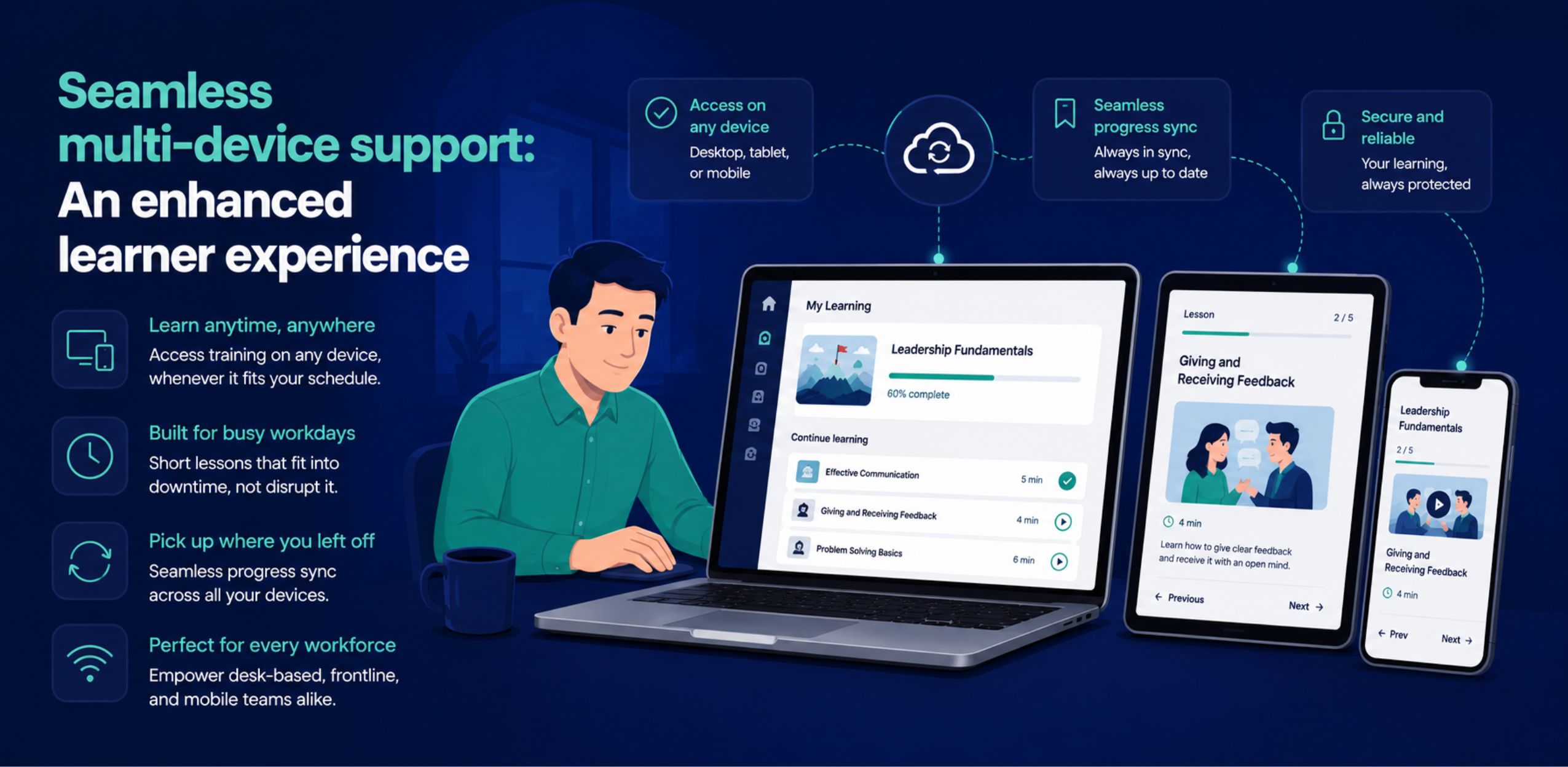
While microlearning makes training more manageable, multi-device support makes it far more accessible. By optimizing your LMS for both desktop and mobile devices, organizations can ensure that employees have access to training whenever and wherever they need it. Rather than being tied to a specific device or location, employees can engage with learning in a way that fits naturally into their day.
This flexibility is particularly valuable for frontline and mobile workforces, who may not have long, uninterrupted periods of time to dedicate to training. Whether an employee is accessing a lesson from their desk, reviewing content on their phone during downtime, or continuing a course while traveling, seamless multi-device support helps remove barriers to learning. When paired with microlearning, it creates a training experience that’s more accessible, more convenient, and, ultimately, more engaging for employees.
Simple is sometimes better
Employee training is an important aspect of HR and workplace management, which is why it’s important that modern training programs evolve to meet the demands of the modern enterprise workforce. Lengthy courses are harder to engage with, can be overwhelming, and it’s easier to forget what you’ve learned when you’ve been subjected to an information overload.
By offering short, easy-to-understand and digestible information packets and allowing employees to access training seamlessly between both desktops and mobile devices, your L&D team can build experiences that are easier to consume, retain and fit into their workday. While long-form training isn’t going away anytime soon, the future of workplace learning is likely to be shorter, more focused, and easier to access. Organizations that haven’t yet explored microlearning may find themselves missing an opportunity to better align training with the way employees learn today.
Platforms like TrainerCentral enable organizations to implement both microlearning and multi-device support into their training programs. With its intuitive course builder, organizations can quickly create engaging microlearning programs without unnecessary complexity. Combined with mobile app support and seamless access across devices, TrainerCentral empowers L&D teams to deliver training that employees are more likely to engage with, complete, and ultimately benefit from. Click this link to learn how you can implement microlearning in your online course.
 Eric Roshaan
A passionate writer with a keen eye for detail, Eric has over four years of experience in marketing. As a product marketer for TrainerCentral by Zoho, he creates content that explores the latest trends in online learning. His interests also span AI, cybersecurity, and IT management, and his articles have been featured by leading publications across the Middle East and Asia Pacific regions.