- HOME
- E-Learning trends
- Building the future of learning: The rise of MEA’s skills economy
Building the future of learning: The rise of MEA’s skills economy
- Last Updated : June 25, 2026
- 102 Views
- 10 Min Read

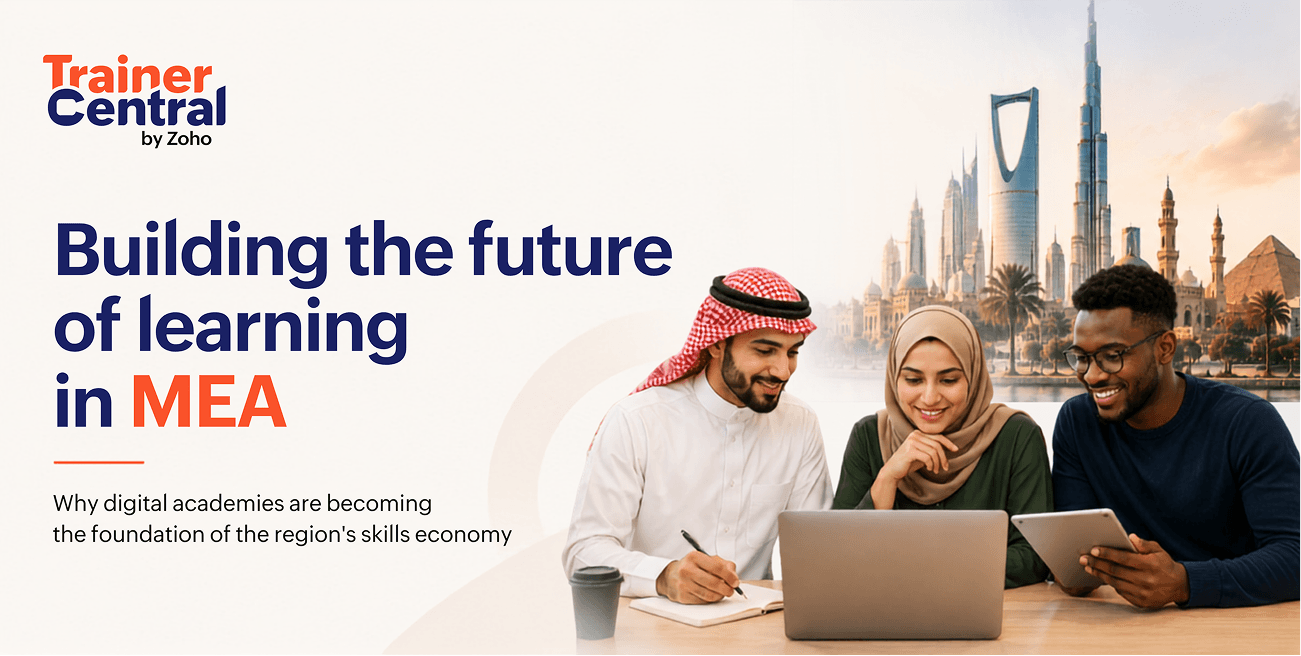
The Middle East and Africa (MEA) region is undergoing a major digital transformation. Over the last decade, governments have invested in digital infrastructure, businesses have accelerated cloud adoption, mobile connectivity has expanded rapidly, and digital services have become part of everyday life across many markets.
But another transformation is now emerging alongside cloud, ecommerce, fintech, AI, and digital government.
The transformation of skills.
Across MEA, governments, businesses, educators, trainers, and individuals are recognizing that long-term growth depends not only on technology adoption, but also on human capability. The ability to learn, adapt, and continuously acquire new skills is becoming a competitive advantage for individuals, organizations, and economies.
This shift is creating a new regional reality.
MEA is no longer simply becoming a digital economy. It’s becoming a skills economy.
In a skills economy, learning isn’t limited to classrooms or occasional workplace training. Knowledge becomes a business asset. Trainers become entrepreneurs. Academies become hybrid learning providers. Companies become educators for employees, customers, and partners. Learners look for flexible, practical, and credible ways to build capabilities that matter in the workplace.
For the region, this is more than an education trend. It’s becoming an economic priority.
Understanding MEA’s learning landscape
MEA isn’t a single market. It includes the Gulf economies, North Africa, fast-growing sub-Saharan digital economies, and selective Levant markets, each with different levels of digital maturity, language needs, purchasing behavior, and training demand.
Saudi Arabia and the UAE are being shaped by national transformation agendas, digital economy goals, and workforce capability programs. Egypt has a large young population and strong demand for affordable career-focused learning. South Africa has a mature professional training and corporate learning environment. Nigeria and Kenya are seeing growth in entrepreneurship, digital skills, creator-led learning, and SME training.
These markets are different, but they share a common direction: Skills are becoming central to economic participation.
The region’s learning needs now extend across:
Youth employability.
Professional certification.
Digital skills.
Corporate upskilling.
Customer education.
Partner training.
Coaching and consulting.
Knowledge entrepreneurship.
Hybrid academies.
Mobile-first learning.
MEA learning opportunity snapshot
While MEA is often viewed as a single region, the drivers of learning demand vary significantly across markets.
Understanding these differences is essential for trainers, academies, and businesses looking to build relevant learning experiences.
Market | Primary learning opportunity |
Saudi Arabia | Workforce capability development, professional upskilling, and Vision 2030 transformation initiatives |
United Arab Emirates | Executive education, coaching, consulting, entrepreneurship, and knowledge businesses |
Egypt | Employability, professional certification, and career-focused learning programs |
South Africa | Corporate learning, professional development, compliance, and certification training |
Nigeria | Entrepreneurship, creator-led education, digital skills, and SME-focused learning |
Kenya | Digital skills development, workforce readiness, and SME capability building |
Despite their differences, these markets share a common trend: Learning is becoming increasingly connected to employability, business growth, and economic participation.
Why skills matter more than ever
The demand for skills development is being driven by demographic, economic, and technological forces.
MENA continues to face one of the world’s most significant youth employment challenges. The International Labour Organization reported that youth unemployment in MENA stood at 24.4% in 2023, almost double the global average. This means roughly one in four economically active young people in the region was unemployed.
At the same time, employers are seeking practical, job-ready skills in areas such as AI, cloud computing, cybersecurity, data analytics, digital marketing, automation, business operations, customer success, and leadership.
The World Economic Forum’s Future of Jobs Report 2025 identifies technological change, economic uncertainty, demographic shifts, geoeconomic fragmentation, and the green transition as major forces reshaping jobs and skills through 2030. The report also highlights skills gaps as one of the biggest barriers to business transformation.
For MEA, this creates both pressure and opportunity.
The pressure is clear: Traditional learning systems alone cannot keep pace with how quickly skills are changing.
The opportunity is equally clear: Trainers, academies, businesses, and learning providers can help close the skills gap by making training more accessible, practical, scalable, and outcome-driven.
The economic forces reshaping learning
Across the region, workforce development is becoming part of national economic strategy.
Saudi Arabia’s Human Capability Development Program, part of Vision 2030, focuses on aligning education outcomes with labour-market needs, fostering innovation, and developing and upgrading skills.
The UAE Digital Economy Strategy aims to double the digital economy’s contribution to non-oil GDP from 12% to 20% by 2030, reinforcing the need for digital capability, workforce readiness, and knowledge-driven growth.
These initiatives reflect a broader shift across MEA: Learning is no longer viewed only as an academic activity. It;s becoming economic infrastructure.
For governments, skills development supports diversification and employment.
For companies, learning supports transformation and competitiveness.
For individuals, practical training supports career mobility.
For trainers and academies, digital learning creates new ways to reach learners and scale impact.
Digital readiness is accelerating learning adoption
The growth of digital learning in MEA is supported by strong digital foundations.
GSMA reports that mobile technologies contributed US$350 billion to MENA’s economy in 2024, representing 5.7% of regional GDP. It also reports that 308 million people in MENA are now connected to mobile internet, with mobile internet subscribers expected to reach 378 million by 2030.
This matters because learning behaviour is changing.
Learners are increasingly discovering educational content on mobile devices, joining live sessions remotely, participating in online communities, and expecting access beyond fixed classroom schedules.
Country-level digital adoption strengthens this picture. DataReportal’s Digital 2026 report shows that Saudi Arabia had 48.7 million cellular mobile connections active in late 2025, equivalent to 140% of the population. The UAE had 23 million cellular mobile connections, equivalent to 202% of its population.
The implication is simple. Learning experiences in MEA must be designed for connected, mobile, and digitally active audiences.
Digital learning is no longer a secondary option. It’s becoming part of how people access opportunities.
The learning market is expanding
The demand for digital learning is no longer limited to schools and universities. It now spans corporate training, professional development, certification programs, customer education, partner enablement, coaching, consulting, and knowledge entrepreneurship.
Grand View Research projects the Middle East and Africa corporate e-learning market to reach US$21.5 billion by 2030, growing at a compound annual growth rate of 23.2% from 2025 to 2030.
This growth reflects a broader change in how organizations think about learning.
Training is no longer only an HR activity. It now supports:
Workforce transformation.
Productivity.
Employee onboarding.
Leadership development.
Compliance.
Customer onboarding.
Partner enablement.
Product adoption.
Digital transformation.
For individuals, learning is also becoming more outcome-driven. Learners want practical skills, flexible access, recognized certificates, and programs that support career progression.
For training providers, this creates an opportunity to build learning experiences that are more structured, credible, and scalable.
The rise of social learning
One of the most important changes in MEA’s learning landscape is the role of social platforms.
Historically, learners discovered expertise through schools, universities, training centres, corporate programs, or professional networks. Today, expertise is increasingly discovered through content.
A leadership coach shares insights on LinkedIn. A digital skills trainer publishes tutorials on YouTube. A creator explains business concepts on TikTok. A consultant builds authority through webinars and short-form video. An educator nurtures a community on Instagram or WhatsApp.
Across Saudi Arabia, the UAE, Egypt, South Africa, Nigeria, and Kenya, social platforms have become powerful channels for learning discovery.
According to DataReportal’s Digital 2026 reports, social media penetration exceeds 90% of internet users in several GCC markets, with platforms such as YouTube, Instagram, TikTok, Snapchat, and LinkedIn forming a significant part of daily digital activity. In Saudi Arabia alone, YouTube reaches more than 90% of internet users, while Snapchat and TikTok continue to maintain some of the highest engagement levels globally.
This shift is changing how expertise is discovered. Many learners now encounter trainers, coaches, consultants, and industry experts long before they visit a training website or register for a course.
Social platforms help trainers and experts build visibility. But visibility alone doesn’t create structured learning. Followers aren’t the same as learners. Content engagement isn’t the same as course completion. Community interest isn’t the same as a sustainable learning business.
This is why digital academies are becoming more important. They help learning providers move from informal content sharing to structured learning delivery.
The emergence of the knowledge economy
The rise of digital platforms has created a new category of professional: the knowledge entrepreneur.
Coaches, consultants, trainers, educators, creators, and subject-matter experts across MEA are transforming their expertise into scalable businesses.
What was once delivered through classroom sessions, consulting engagements, workshops, or one-on-one coaching can now be packaged into:
Online courses.
Live workshops.
Cohort programs.
Memberships.
Certification programs.
Learning communities.
Digital academies.
Customer education portals.
This represents a broader evolution in the economy itself.
Knowledge is becoming a monetizable asset. Expertise is becoming a business model. Education is becoming more creator-driven, community-led, and digitally distributed.
For many professionals, learning is no longer simply something they deliver. It’s the foundation of their business.
From classrooms to hybrid academies
Classroom learning remains important throughout MEA.
Professional training centres, vocational institutions, exam-prep providers, certification bodies, corporate trainers, and academies still rely heavily on instructor-led learning. This will not disappear.
But expectations are evolving.
Learners increasingly want:
Flexible access.
Hybrid experiences.
Recorded content.
Digital resources.
Mobile access.
Community engagement.
Continuous support.
Certificates and assessments.
As a result, learning providers are moving beyond purely physical delivery models.
The digital academy is emerging as a practical model for this shift.
A digital academy doesn’t replace classroom learning. It extends it. A live workshop can become part of a larger learning journey. A classroom program can include self-paced modules, assessments, discussions, certificates, and follow-up resources. A one-time session can become a repeatable program.
This helps training providers expand beyond one classroom, one location, or one instructor schedule while maintaining the credibility and human connection that make instructor-led learning valuable.
Businesses are becoming educators
MEA’s learning economy isn’t only about individual learners and training institutes.
Businesses themselves are becoming education providers.
Companies now need to train:
Employees.
Customers.
Partners.
Resellers.
Franchise teams.
Product users.
Communities.
As products become more sophisticated and industries change more rapidly, education becomes a strategic business function.
Workforce learning helps companies keep teams aligned with new tools, processes, and market needs.
Customer education helps users understand products faster, reduce dependence on support teams, and improve adoption.
Partner education helps businesses create consistency across distributors, resellers, consultants, and service networks.
This means teaching at scale is becoming a competitive advantage.
A company that can educate its employees, customers, and partners effectively is better positioned to grow in a digital-first economy.
Why trust matters in MEA learning
Technology can make learning accessible, but trust makes it meaningful.
Across MEA, learning decisions are often influenced by reputation, referrals, community recommendations, trainer credibility, institutional trust, and perceived career outcomes.
Learners want confidence that a program is worth their time and investment. Organizations want confidence that training will improve performance. Parents, employers, and professional communities often influence education and training choices.
This is why credibility matters.
The most successful learning providers aren’t only those with strong content. They’re the ones who can present learning in a structured, professional, and trusted way.
Professional branding, clear learning journeys, learner communities, assessments, certificates, testimonials, and consistent delivery all help build trust.
In employability-driven markets, certification is especially important. Certificates help learners signal progress, demonstrate completion, and build confidence in their professional development journey.
The future of learning in MEA
The future of learning in MEA will likely be shaped by several interconnected trends.
Continuous learning
Skills will need regular updating as industries evolve. One-time training will give way to ongoing development.
Hybrid education
Physical and digital learning experiences will increasingly coexist. Classrooms will remain important, but digital access will expand reach and flexibility.
Mobile-first experiences
Learning will continue moving closer to where people already spend their time—on mobile devices and connected platforms.
Community-centred learning
Peer interaction, discussion, and learner engagement will become more important, especially in trust-driven markets.
Knowledge entrepreneurship
More professionals will build businesses around expertise, turning coaching, consulting, and training into structured learning products.
Workforce transformation
Organizations will invest more heavily in upskilling, reskilling, employee academies, and customer education.
Together, these trends point toward a future where learning becomes a permanent component of economic growth.
Supporting the next generation of learning providers
As the region’s learning ecosystem evolves, trainers, academies, businesses, and organizations need ways to create structured, scalable, and engaging learning experiences.
Modern learning platforms play an increasingly important role in helping providers move beyond isolated courses and one-time training sessions and toward more complete learning ecosystems.
They bring together content delivery, live instruction, assessments, certifications, communities, learner engagement, and business management capabilities within a unified environment.
This enables learning providers to focus less on operational complexity and more on creating meaningful learning outcomes.
How TrainerCentral supports MEA’s learning transformation
TrainerCentral is designed for trainers, academies, and businesses that want to create, manage, and scale digital learning experiences.
It helps users create courses, build websites, nurture learner communities, reach learners worldwide, and monetize knowledge from one platform.
TrainerCentral’s virtual classroom also enables trainers to conduct live workshops, virtual training sessions, and one-on-one coaching for remote learners.
For MEA’s evolving skills economy, this matters because learning providers need tools that support both delivery and growth.
Trainers can turn expertise into structured programs. Academies can move from classroom-only delivery to hybrid learning. Organizations can create internal learning programs for employees. Businesses can build customer and partner education academies.
By bringing together courses, live workshops, communities, assessments, certificates, payments, and branded academy experiences, TrainerCentral supports the broader regional shift from one-time training to continuous learning.
Addressing MEA’s learning challenges
As MEA’s skills economy grows, trainers, academies, and businesses face common barriers to delivering scalable, accessible, and trusted learning experiences.
The table below highlights some of the most significant learning challenges across the region and how TrainerCentral helps address them.
Learning challenge | Regional impact | How TrainerCentral helps |
Skills development | Organizations must continuously upskill employees as AI, automation, cloud technologies, and digital transformation reshape workforce requirements. | Create structured learning pathways with self-paced courses, live training, assessments, and certifications. |
Youth employability | Young professionals increasingly need practical, workforce-ready skills and recognized credentials. | Build career academies, certification programs, vocational learning experiences, and skills-based training programs. |
Training scalability | Classroom capacity, geography, and instructor availability limit growth for training providers and academies. | Deliver hybrid learning through live workshops, recorded sessions, and self-paced learning programs that extend beyond physical locations. |
Training administration | Managing learners, registrations, assessments, certifications, communications, and payments across multiple systems creates operational complexity. | Centralize learner management, course delivery, assessments, certifications, payments, and academy operations within one platform. |
Workforce transformation | Businesses require ongoing reskilling and upskilling initiatives to remain competitive in a rapidly changing economy. | Build internal academies, workforce development programs, role-based learning paths, and measurable learning journeys. |
Customer education | Customer onboarding, product education, and partner enablement become difficult to scale as organizations grow. | Create customer academies, onboarding programs, certification pathways, and partner training portals. |
Trust and credibility | Learners increasingly seek trusted institutions, recognized certifications, and professional learning experiences. | Launch branded academies with custom domains, certificates, assessments, communities, and structured learner journeys. |
Mobile-first learning | Most learners now access educational content primarily through smartphones and connected devices. | Deliver mobile-friendly live and self-paced learning experiences across devices. |
Hybrid learning demand | Learners increasingly expect a combination of classroom and digital learning experiences. | Combine virtual classrooms, self-paced courses, recordings, communities, and assessments into a single learning ecosystem. |
Building the skills economy
The next phase of MEA’s growth will be driven not only by technology, infrastructure, and investment. It will also be driven by people.
By learners seeking opportunity.
By organizations investing in workforce capability.
By experts sharing knowledge.
By academies expanding access to education.
By businesses recognizing learning as a strategic advantage.
As the region continues its transformation, the ability to create, share, and scale knowledge will become increasingly valuable. And for trainers, academies, and businesses across MEA, digital academies offer a way to build that future with greater access, trust, structure, and scale.
In the emerging skills economy, learning is no longer simply preparation for the future. It is becoming one of the region’s most valuable forms of capital and one of the forces shaping MEA’s next chapter of growth.
Sources:
1. International Labour Organization
2. World Economic Forum
3. Saudi Vision 2030
4. GSMA
5. DataReportal – Global Digital Insights
6. Grand View Research