- HOME
- E-Learning trends
- 12 reasons learners drop out of your course and how to fix them
12 reasons learners drop out of your course and how to fix them
- Last Updated : May 5, 2026
- 246 Views
- 9 Min Read

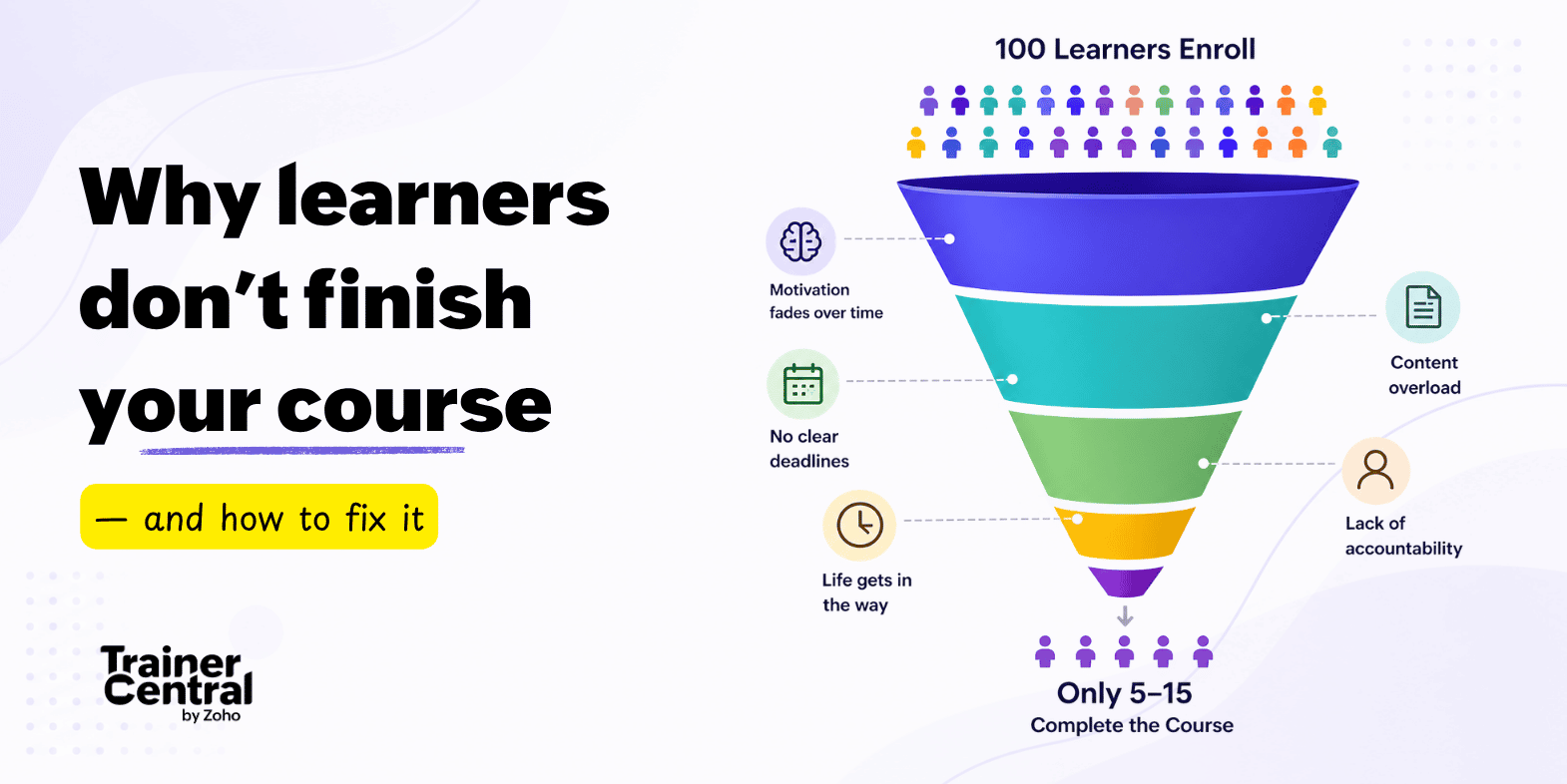
Most course creators, when they see their completion rates, come to the same conclusion: the course content must be the problem. Maybe the videos are too long. Maybe the modules are dry. So they trim lessons, add animations, break things into chunks. But the completion rate barely moves.
Here's the thing: Content quality is just one piece of a much bigger picture. A genuinely great course still gets abandoned all the time, by learners who were excited when they signed up. The moment someone clicks Enroll, they’re up against how their brain processes reward, a life that doesn’t pause for their goals, and a format that removes every guardrail that normally keeps people accountable.
Fixing completion rates starts with understanding the full picture. This article covers all 12 reasons learners drop out, what to do about each one, and how the right LMS can handle several of these fixes at scale.
Why learners drop out, and the fix for each one
The data is brutal. Across MOOCs on Coursera, edX, and similar platforms, completion rates are less than 10%. That's been the case for over a decade. For every 100 people who enroll, between 70 and 95 will leave before finishing. Here’s why.
1. Buying the course already felt like progress
When someone hits Enroll, their brain registers a small win. That feeling is surprisingly good at substituting for actual learning. The purchase itself triggers a dopamine response the brain mistakes for progress. By the time they open lesson one, the emotional high has passed.
The fix: Launch an onboarding sequence that starts within minutes of enrollment. Give the learner one specific action. Not “explore the course,” but watch this 3-minute video or complete lesson one today. Learners who do something in the first 24 hours are far more likely to keep going. That first step is worth more than any welcome copy.
2. They signed up at a peak moment they can’t sustain
People enroll during windows of high motivation. Like after a frustrating review, or after watching an inspiring talk. That peak fades within days. Research on procrastination consistently describes this as the intention-action gap. That is, people have genuine intentions, but the challenge is always converting them into sustained action.
The fix: During onboarding, get learners to write down, in their own words, why they enrolled and what they want to achieve. Sometimes this is called a learning contract. At the two-week mark, send a reminder that reflects their stated goal back to them. It’s a small thing that keeps the original motivation from going completely cold.
3. No one notices when they’re gone
In a physical classroom, absence has a social cost. Online, a learner can go silent for three weeks and nothing happens. Studies consistently identify isolation and the absence of community as a leading cause of attrition. When disappearing is frictionless, people disappear.
The fix: Create any structure where learners interact with at least one other person. A monthly live Q&A, a peer feedback assignment, a discussion prompt at the end of each module. The interactions don’t need to be deep, they just need to exist. If you run community-based learning, this is partially solved by design. Self-paced courses need this structure to be built deliberately.
4. “Self-paced” works like a trap
Unlimited flexibility means unlimited ability to defer. “I'll get to it this weekend” works fine until eight weekends pass. Research on self-regulation in online learning shows that the absence of deadlines is a significant predictor of dropout.
The fix: Offer a suggested schedule alongside open access. “Most learners complete this in 6 weeks, learning about 2 hours per week. Here’s a week-by-week breakdown.” You’re not locking anyone in. You’re giving them a pace to follow. Most people will follow it, because a plan removes the daily question of how much to do today. For better results, drip releases, where content unlocks on a schedule for a group moving together.
5. Friction kills momentum
Things like logging in, finding where you left off, and choosing a module feel like non-decisions. After a full workday, they’re not. Decision fatigue is well-documented. The more choices we make, the more our capacity to make further ones degrades. When the platform is clunky, people close the tab.
The fix: Make sure learners land exactly where they left off when they log back in. Send weekly emails that link directly to the next lesson, not the course homepage. A visible progress indicator like “Lesson 4 of 9” does more than you’d think. On mobile, make sure the experience actually works. A surprising number of learners try to study on their phones during commutes, and a broken mobile layout ends that session immediately.
6. The course is too much
When a learner opens your course and sees 14 modules and 60 videos, the gut reaction is dread. Content overwhelm is one of the most commonly cited reasons learners disengage. Learners don’t want everything you know. They just want the outcome you promised.
The fix: Go through your course and ask, for each lesson: if a learner skipped this, would it break their understanding of what comes next? If no, it’s a candidate for removal or a bonus section. Shorter, tighter courses with a clear endpoint consistently outperform longer ones. More content isn’t more value.
7. The reason they enrolled wasn’t strong enough
Learners who sign up because of a sale, a manager’s request, or vague obligation rarely finish. Research on motivation consistently finds that internal motivation is what sustains behavior over time. External motivation gets people in the door. It doesn’t keep them there.
The fix: Frame each module around what learners will be able to do when they finish, not what they’ll learn. “After this module, you’ll know exactly how to price your first offer” lands differently than “Module 3: Pricing.” Also, during onboarding, ask learners what they’re specifically hoping to achieve. The ones who can answer precisely are the ones who finish.
8. They paid too little to care
A heavily discounted course costs almost nothing to abandon. When the psychological cost of quitting is near zero, quitting is easy. Loss aversion works in reverse here. The higher the price, the more a learner feels compelled to finish what they started.
The fix: Raise your price if you can. Course creators who move from marketplace-style pricing to direct sales consistently report better completion alongside higher revenue. If you’re staying at a lower price point, build in other forms of investment. Require learners to complete a pre-course worksheet or attend a live kickoff before getting full access.
9. No one ever got back to them
A learner gets stuck, posts a question, waits a week, hears nothing, and stops. Peer-reviewed dropout research consistently puts lack of instructor responsiveness among the top reasons learners quit. It’s not the course quality, but the human availability.
The fix: At small scale, check forums and messages regularly, and reply within 24 hours. At scale, train a teaching assistant, keep a pinned FAQ updated, and set up auto-responses that acknowledge questions immediately. Some creators use a Slack or Discord community where learners answer each other. This helps distribute the load and builds accountability at the same time.
10. The content doesn’t connect to anything real
Theory without application has a short shelf life. When learners can’t connect what they’re studying to an actual problem they’re working on, the material stops feeling relevant. Research on online disengagement identifies a lack of practical application as a consistent dropout driver.
The fix: Add an action at the end of each module. “Draft your first outreach email using the template from lesson 3.” “Calculate your pricing using the formula we covered.” Short, applied exercises that tie lesson content to the learner’s actual situation are what separates courses people remember from ones they forget.
11. The course didn’t deliver what was promised
When the material doesn’t match the sales page, learners leave out of disappointment. Mismatched expectations are a documented dropout trigger. The gap between promise and lesson one sets the tone for everything that follows.
The fix: Be specific on your sales page about what the course covers, how long it takes, and who it’s not for. A learner who self-selects out before enrolling isn’t a loss. Inside the course, start each module with a brief preview of what’s coming and what learners will be able to do when they finish it. Small previews reduce the anxiety of not knowing what’s coming.
12. The brain prefers right now over later
A promotion, a new skill, a certificate, all feel a bit distant. But scrolling a phone feels immediate. Research published in Scientific Reports found a direct correlation between how much people discount future rewards and how much they procrastinate. The further away the payoff feels, the less motivating it becomes.
The fix: Break the reward cycle into shorter loops. Milestone badges after module one, halfway, after the first practical exercise. A visible progress bar or quick feedback when a learner submits work goes a long way for maintaining motivation. The closer the reward is to the action, the more the brain values it. One certificate at the end isn’t enough.
How the right LMS amplifies all of this
Most of the fixes above work. The problem is consistency. You can’t personally welcome every enrollee within the hour, track who went quiet in week two, or send a re-engagement nudge to the person who hasn’t logged in for 10 days. This is where the right LMS shifts from a hosting tool to an active part of your retention strategy.
Drip scheduling and automated onboarding: A good LMS lets you release content on a schedule, so learners don’t land on a dashboard with 60 lessons waiting. They get lesson one today, lesson two next, with a paced path that feels manageable. Automated welcome sequences can trigger the moment someone signs up. A prompt to complete a goal-setting exercise or a direct link to lesson one can help convert enrollment energy before it dissipates.
Progress tracking and re-engagement triggers: Your platform should show you, at a glance, which learners are active and which have gone quiet. That’s an early warning system. Some platforms automate re-engagement nudges when a learner hasn’t logged in after a set number of days. Not as personal as a one-to-one message, but it works at a scale that personal outreach can't.
Built-in live sessions: Platforms with an integrated live classroom (not just a Zoom link) make it easy to run Q&As without learners switching tools. Features like live polls, in-session quizzes, and breakout rooms turn passive viewing into something participatory. Learners who interact during a live session are more likely to come back for the next one.
Assessments, certificates, and badges: A platform that supports assignments and auto-graded assessments lets you build application moments into the course flow. Certificates learners can share on LinkedIn, paired with milestone badges at meaningful points, give the brain something to move toward, and make finishing feel real rather than abstract.
Built-in community and mobile access: An integrated discussion forum tied to specific lessons gets used. A separate Facebook group gets forgotten. And a proper mobile app removes friction for learners who study between meetings or on a commute.
If you want all of this without stitching five tools together, TrainerCentral is worth a look. It’s built not just to host your course, but to help your learners actually finish it.
Wrapping up
A low completion rate isn’t a verdict on your expertise. It’s feedback on the experience built around your expertise. The knowledge contained in your course may be genuinely excellent. The problem is seldom the knowledge. It’s the onboarding, the pacing, the accountability structures, the moments where a learner hits a wall and finds no one on the other side.
You don’t need to fix all 12 things this week. Pick the one or two that feel most true for your learners right now. Maybe the course has too much content and people get overwhelmed in week two. Fix that first. Maybe there’s no re-engagement system and learners silently disappear. Start there.
A learner who finishes and gets a real result becomes your best marketing tool. They post the certificate, recommend you to a colleague, and come back for your next course. The economics of a high-completion course are fundamentally different from one where most learners churn quietly.
The question isn’t just how to get more people to buy. It’s how to build something worth finishing.