- HOME
- E-Learning trends
- Saudi Arabia’s skills transformation: The changing role of professional training
Saudi Arabia’s skills transformation: The changing role of professional training
- Last Updated : August 28, 2026
- 107 Views
- 6 Min Read


Saudi Arabia’s economic transformation is changing not only industries and employment, but also the infrastructure through which people build skills. Under Vision 2030, the Human Capability Development Program places future labor-market readiness, lifelong learning, reskilling, upskilling, and stronger links between education and employment at the center of national development.
What makes the Saudi market distinctive is the ecosystem forming around that ambition: ministries, regulators, employers, technical and vocational institutions, private training providers, education-technology companies, professional-certification providers, and digital learning platforms. Professional training is increasingly becoming part of a continuous skills economy rather than a stand-alone course market.
A labor market that’s changing in size and structure
The Ministry of Human Resources and Social Development reported Saudi unemployment at 6.8% in Q2 2025, with about 2.47 million Saudis employed in the private sector. As private-sector participation grows and sectors such as technology, finance, healthcare, engineering, tourism, logistics, manufacturing, and energy become more specialized, skills alignment becomes as important as job creation.
Professional development has to support a longer workforce journey: pre-employment preparation, occupational capability, professional development, specialization, reskilling, career mobility, and continuous learning. The shift is from delivering isolated training to building capabilities that remain relevant as jobs change.
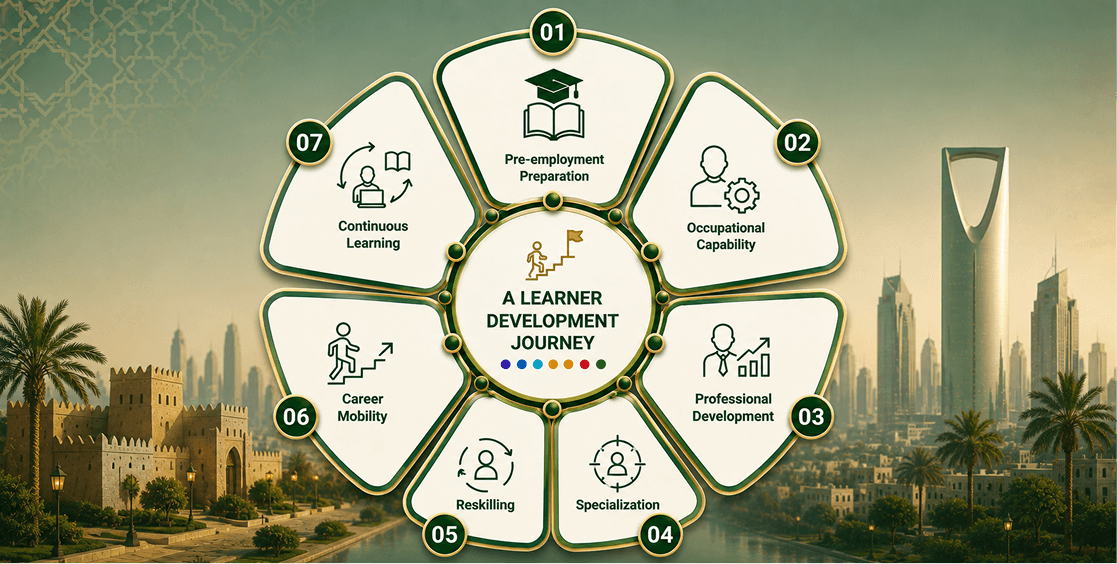
Saudi Arabia is moving from qualifications to skills
The National Skills Platform is one of the clearest examples. Launched through the Skills Accelerator Initiative, it aims to qualify more than 300,000 people for strategic sectors. MHRSD says the platform uses artificial intelligence to classify skills and guide people toward learning pathways aligned with labor-market requirements; a 2026 Saudi Press Agency update also confirms its use of AI for skills records, learning pathways, and assessments.
The Skills Accelerator offers more than 3,000 training programs across seven high-impact sectors, including tourism, industry, transport, retail, energy and mining, financial activities, and healthcare. The underlying logic is capability-first: Identify the skills the economy needs, then build the learning pathways that develop them.
Employers are being brought directly into the training system
The Ministry’s Wa’ad National Training Campaign makes private-sector participation explicit. Its first edition exceeded one million training opportunities; at the launch of the second edition, more than 58 partners participated and the Ministry announced a target of nearly three million opportunities. By June 2026, MHRSD was still describing the second edition as targeting three million training opportunities by 2028, alongside regional forums and cooperation agreements with government and private entities.
Wa’ad shows that workforce development is increasingly a shared responsibility between government and employers. That expands the role of corporate academies, specialist training businesses, industry experts, technology providers, and professional learning partners.
Saudi Arabia is also subsidizing access to professional training
Demand-side funding is another layer. The Human Resources Development Fund’s Maharat product supports general and specialized professional training through licensed providers for eligible Saudi job seekers and private-sector employees.
HRDF can support training costs up to SAR 1,200 per program for remote general-skills training, SAR 2,000 for classroom general-skills training, SAR 1,800 per month for remote professional-skills training, and SAR 3,000 per month for classroom professional-skills training. These are maximum ceilings; approved amounts can be lower and payments go to the training provider.
Licensed providers can also register and manage courses for Maharat support, subject to accreditation requirements. For remote programs, applicable National eLearning Center requirements also matter. Saudi Arabia is not only encouraging skills acquisition; it’s using public funding to direct learners toward approved training and qualified providers.
A national digital-learning infrastructure is taking shape
FutureX, the National eLearning Platform, operated by the National eLearning Center, is becoming an important part of this infrastructure. Its current platform reports 640+ service providers and 2,000+ beneficiary entities and is designed to integrate providers and beneficiaries across Saudi Arabia’s e-learning ecosystem.
FutureX now provides services for technical integration, program licensing, content development, professional subscriptions, and other digital-learning needs. Technical integration verifies an entity’s readiness to deliver e-learning against NeLC standards, while program license issuance formalizes electronic education and training programs.
This matters because learning technology is being treated as infrastructure, not merely software procurement. Providers, institutions, and organizations are being connected through a national framework for trusted digital delivery, standards, licensing, and shared services.
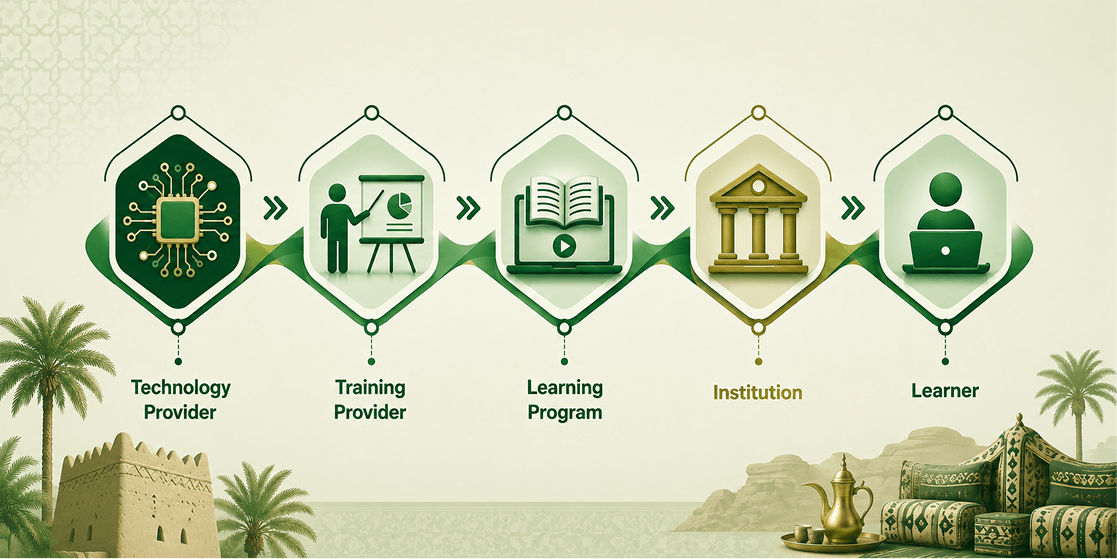
Regulation is evolving alongside market growth
In March 2026, NeLC announced unified licensing procedures with TVTC for private-sector e-learning and training programs. From May 2026, training providers can obtain program licenses through TVTC after completing technical-integration requirements with NeLC systems through FutureX.
The direction is clear: Saudi Arabia is simplifying participation while making quality, licensing, and technical compliance more structured. FutureX also provides mechanisms to report unlicensed programs, reinforcing verification and transparency.
For professional learning providers, credibility increasingly rests on provider quality, program licensing, structured delivery, assessment, certification, and transparent learner journeys—not branding alone.
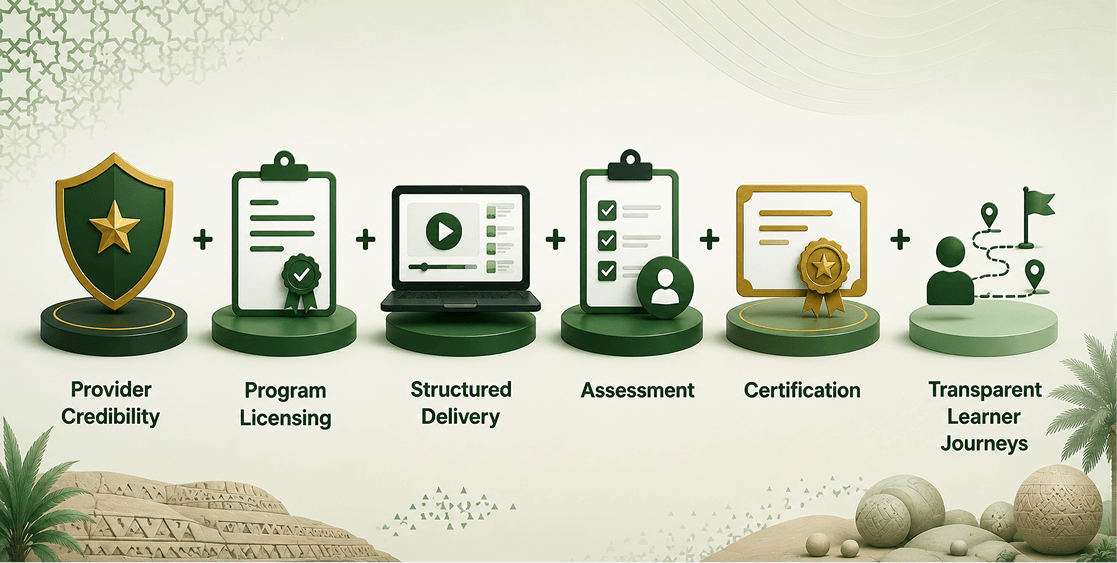
Technical and vocational education is becoming increasingly digital
TVTC reported 336,150 trainees and 98,716 graduates in 2024 across 314 training facilities. Its Taqni e-learning platform reached 237,841 beneficiaries and 65,067 electronic courses in 2025, with analytics, customization, knowledge resources, and an AI-powered virtual assistant.
Industry partnerships are also deepening. TVTC’s international academies include Microsoft, Cisco, Oracle, Huawei, and SAP. In the first training semester referenced by TVTC, 76,575 trainees participated across 220 accredited academy branches. This shows how employers, technology companies, institutions, and public programs increasingly intersect in professional education.
SMEs and technology providers sit inside a wider enablement ecosystem
Monsha'at maintains a directory of government support programs for SMEs, while its Virtual Labs Platform connects entrepreneurs with service providers and can issue support vouchers that partially or fully cover eligible service costs after evaluation. The program focuses on innovation and prototyping rather than LMS procurement, but it illustrates a broader Saudi model: government platforms matching businesses with qualified private providers and, in some cases, subsidizing access.
Technology companies also have dedicated support. The National Technology Development Program’s Tamkeen initiative offers qualifying technology SMEs subsidies of up to SAR 86,000 per technical employee for up to 18 months. MVPLab has offered grants of up to SAR 150,000 plus mentoring, workspaces, consultations, and training for qualifying technology entrepreneurs. These aren’t customer grants for training software, but they show that Saudi Arabia is supporting both organizations that digitize and companies that build the technology enabling that digitization.
What this ecosystem means for professional training providers
Taken together, the Kingdom is building multiple layers at once: national skills direction through Vision 2030; skills intelligence through the National Skills Platform; training demand through Wa’ad and the Skills Accelerator; funding through Maharat; formal delivery capacity through licensed providers; digital regulation through NeLC and TVTC; technology infrastructure through FutureX; and trust through licensing, accreditation, assessment, and certification.
The result is an increasingly interconnected professional-learning economy.
The role of TrainerCentral in this changing environment
TrainerCentral is designed for trainers, training institutes, and organizational learning teams. It brings together course creation, live learning, assessments, certification, learner engagement, communities, branded academies, payments, and training-business management. Explore TrainerCentral’s capabilities in more depth here.
For Saudi providers, the value is the ability to support the full learning lifecycle: create, deliver, engage, assess, certify, track, and improve. A training institute can combine instructor-led and self-paced programs; an academy can manage certification journeys; a company can educate employees, customers, or partners; and a specialist trainer can turn workshops into repeatable programs.

TrainerCentral 2.0 extends this with SCORM support, academy-wide communities, standalone assessments, AI-assisted course building, content protection, and secure assessment delivery—capabilities relevant as Saudi training organizations build more sophisticated institutional and professional programs.
From training activity to skills infrastructure
Saudi Arabia has moved beyond asking whether workforce training matters. The challenge now is making skills development continuous, measurable, accessible, trusted, and closely connected to economic demand.
National skills frameworks, employer-led initiatives, public training support, digital-learning regulation, government-backed platforms, qualified providers, professional certificates, industry academies, and technology partners are increasingly operating as one system. For training providers, the opportunity isn’t simply to create more courses, but to become part of the infrastructure through which people, companies, and industries continuously build capability.